

Once again I am privileged to review a new book by Paul Belasik
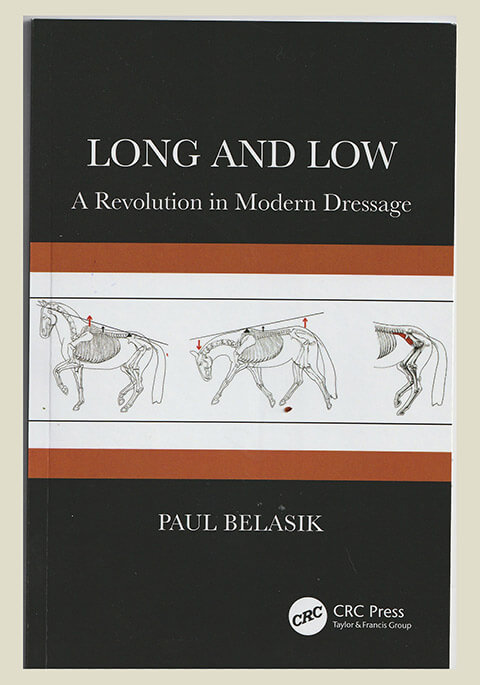
Long and Low, A Revolution in Modern Dressage (CRC Press)
Paul Belasik is an equestrian jewel, sadly he is also one of the few remaining specimens of a dying species, the serious dressage commentator. In a series of books, Paul has demonstrated his deep research into the writings of the equestrian greats, combined with refreshing insights of his own, which include eastern philosophy, and the martial arts. In this new work he confronts one of the burning issues of the day, long and low, which he sees as the implacable enemy of the true goal of the equestrian art – collection.
Paul sheets home the blame to the German military:
At the time of writing his book “Classical Dressage Training in Practice According to the H. Dv. 12,” Gert Schwabl von Gordon was by his own description, the last living representative of the Cavalry School of Hanover, Germany. He felt obliged, he said, “to elucidate the principles of the classical art of riding as they were understood and cultivated at the world-renowned school” (9). However, as we’ll see, they had redefined “classical.” Schwabl von Gordon presents us with a unique eye-witness account of the birthplace of long and low. He goes on to explain how the north star of the training at the Calvary School of Hanover, was the H. Dv. 12.
The H. Dv. 12 was the German Cavalry Manual on Training the Horse and Rider; army regulations 12. These regulations are brief in their guidelines. There is not a lot of information or explanation of long and low, or how to achieve it, and what is there can appear to be contradictory. In the manual under the section Part C. Schooling of Horses, XI. Dressage Horses during the First and Second Year, it goes on to talk about looseness (losgelassenheit). It says, “The horse must learn to regain the posture that it has found without rider and move just as unconstrained – with a long neck and a low nose – under the weight of the rider. If it is able to maintain this unconstrained movement, it is ‘loose’ (98).” Finally, it is stated in bold letters, “Looseness [losgelassenheit] of the horse is the basic precondition for the success of the entire dressage” (98).
Paul takes issue with this – It is interesting how nonchalantly this revolutionary idea, that a horse’s natural posture in movement “with a long neck and a low nose,” is laid out for all of the riders of the German cavalry. It is an order issued from regulations to be obeyed, that this posture is a precondition for the entire success of dressage.
What did this long and low look like, and what was it supposed to do? According to Schwabl von Gordon, “Here is a summary of the most essential features of riding long and low. Two equally important criteria should be emphasized here: stretching the horse’s neck and dropping it down while yielding the poll with the nose of the horse on the vertical. The horse shouldn’t loll around on the bit — ie, the rider shouldn’t allow the horse to have a fifth leg. Instead, there should be a light, but constant contact between the rider’s hands and the horse’s mouth. To designate the point of the shoulder as the fixed point of reference for lowering the neck is erroneous because only by really stretching downward as though the horse is tracking something or looking for truffles, can the rider ensure that the horse, its back and the broad muscle (latissimus dorsi) is stretching as well” (17).
He goes on to say the engagement of the hindquarters is not the objective, only suppleness. This suppleness will somehow “create the conditions necessary for engagement of the hindquarters in the working frame. (17). There is no explanation for how this is supposed to evolve into collection.
As usual when I read one of Paul’s books, I do not agree with everything he writes.
Early when I started trying to ride dressage, I was lucky enough to train with Oswald Johnen, a graduate of the German system at Warendorf. Oswald made it clear that starting the work on a longer rein, with a stretched neck, was to build ‘the power to thrust’, and that as we worked through the elements of the training scale, our aim with exercises like shoulder in, transitions, half pass, voltés etc was very firmly to develop ‘the power to carry’ – collection.
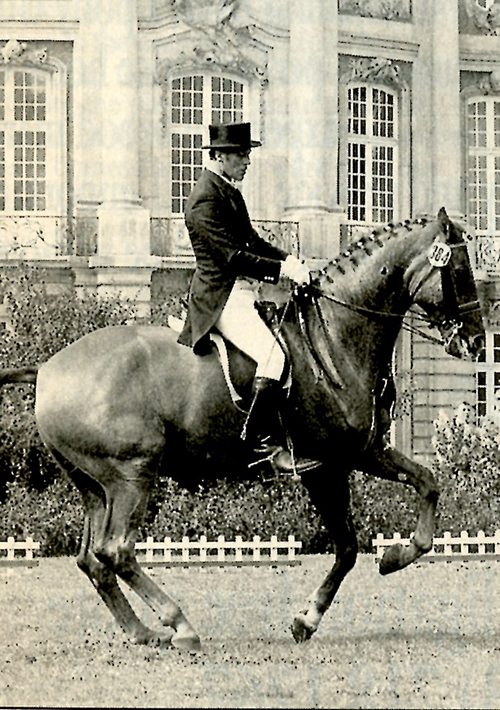
Harry Boldt one of the great authorities on German Dressage – collected?
Back to Paul and von Schwabl: However to be fair, there is cursory acknowledgement that this all be done with a light rein. There is also instruction that the horse should “immediately comply with the request from the outside regulating rein, have the horse stretch into the long and low position!” (Schwabl von Gordon 18). It does not take much imagination to see how the scene Baron Biel describes of riders in the German schools riding with horses “overbent, their heads pulled down in an unnatural manner,” could have developed with the chief instructors teaching this system of immediate compliance of the horse to lower its head. (Podhajsky, 20).
One of Paul’s great strengths is his willingness to examine history as a key to understanding the issues of today. If long and low was so clearly at odds with the classical theory and system, where did this revolutionary new dressage training get its power from?
Long and low’s appearance in the late 1800’s coincides with the dissolution of the world’s cavalries and the birth of competitive dressage. With the advances in mechanized warfare, the cavalry became obsolete. Facing the threat of the loss of their jobs, many of the military horsemen embraced an expansion of riding to include the public. Forward-thinking horsemen like the controversial German, Gustav Rau, championed the repurposing of cavalry and farm horses to breed modern sport horses. (In a relatively short time, two world wars would decimate Germany. They had little to rejoice in besides their horses.)
After some stinging losses for German riders in 1928, Rau founded a special dressage stable at the Cavalry School of Hanover.
Rau installed Otto Lörke to run the program. Lörke fitted the mould. He learned the German military system when he was serving his time with the Ulan Regiment of the Royal Prussian Guards. Lörke was by all accounts not an elegant rider, but would prove to be good in the new sport of dressage. It was at Hanover that he began to develop a machine producing competition horses and riders that could win.
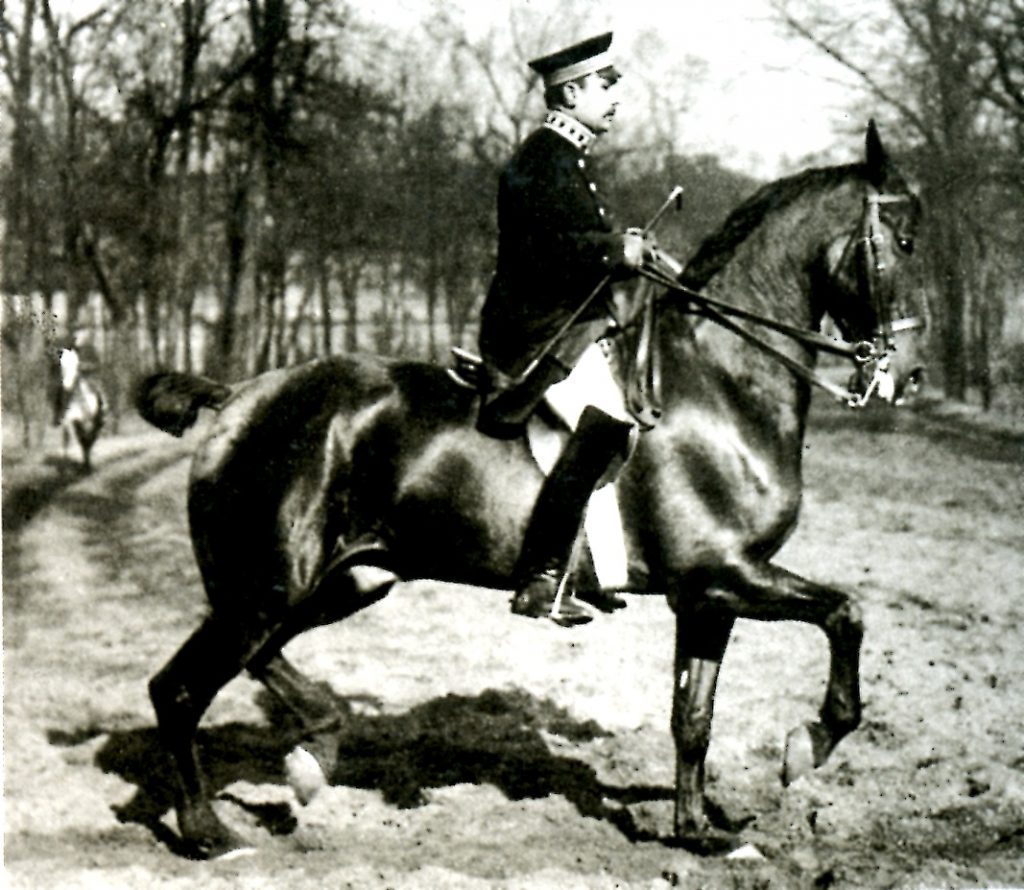 Otto Lörke and Fanal
It became clear that the marketing experts of the burgeoning dressage industry were aware of the optics of German officers riding German horses in a sport of precision riding. It wasn’t long before Lörke presented a team of young women riders, two trained by him and the third by his student Willi Schultheis. In 1956, Liselott Lisenhoff, Anneliese Kuppers and Hannelore Wiegand brought home a silver medal from the Stockholm Olympics. The warmblood was now a horse for everyone, every demographic. With the German horse however, came an official owner’s manual. It was not the manual of Steinbrecht with his emphasis in the classical elements of dressage, it was a continuation of the German military style. Even at the highest levels the emphasis seemed to be on the front ends of the horses. Many photographs and even Schultheis’s instructional videos demonstrate horses disconnected, exaggerated in the front end and with difficulty engaging the hind end. The rider was not balanced over the leg, but was heavy-seated.
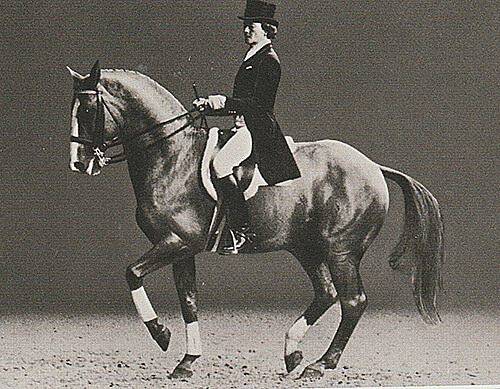
Once again, I differ from my friend, the photo of Linsehoff on Piaffe would seem to me pretty near perfect.
“These principles of the classic art of riding were put into practice at the Cavalry School of Hanover and were so successful that Germany’s riders from the Calvary School won all six of the Equestrian gold medals in the 1936 Olympic Games in Berlin in individual as well as team competitions” (Schwabl von Gordon, 12). In reality, it wasn’t the principles that were entirely responsible for the results. Schwabl and the German military had one narrative, but there was another from Podhajsky who was a medallist at these very same Olympics.
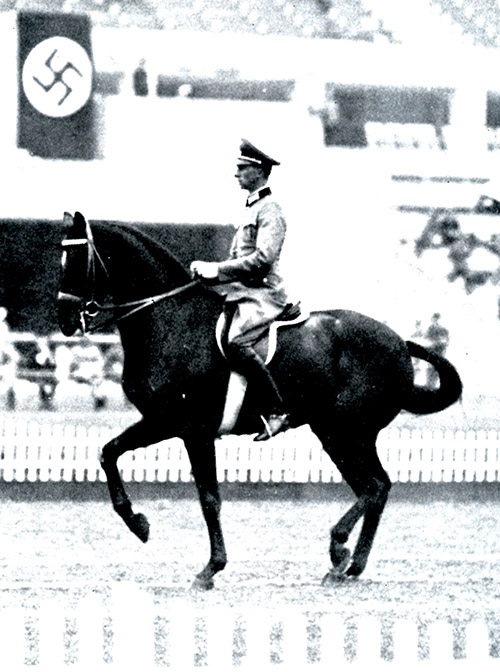
The German gold medallist, Kronos
In My Dancing White Horses he writes “…after a long wait, the result of the main dressage event was announced: “Kronos (Germany) first, 15 points; Absinth (Germany), second, 18; Nero (Austria), third, 19; Theresa (Sweden), fourth, 26,” and so on. I also noticed all round me too a great deal of head shaking over this result which was discussed everywhere, including the newspapers. The German judge was responsible for pushing me back into third place, because he not only put his own three countrymen first, second, and third, but placed me only seventh, unlike his four fellow judges, who had all put me somewhere in the first four.”
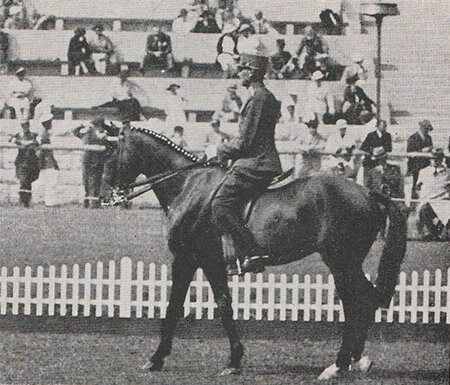
Podhajsky and Nero
Once again I differ from both Podhajsky and Paul. Rau published a book on those Games, with lots of photos (no ClipMyHorse in those days) but looking at the German Gold Medal winners, H. Pollay and his horse Kronos, and one of the photos of Podhajsky and his Nero, gives me the feeling that perhaps the judges got it right.
Paul also makes the point (along with a number of others that I am not touching on in this small review) that the taste of the judges switched to emphasize the talents of the Warmblood, with that I agree. When I first started reporting on international dressage, at every show there with a team of Lippizaners ridden by tall men with impressive moustaches, but gradually they, like the Andalusians, disappeared as the emphasis on the extended trot became the major focal point.

Charlotte Dujardin – short and high?
Today the challenge is from the very ugly phenomenon, the reverse of long and low, short and high. This practice seems to have originated in The Netherlands, but has spread, even to such previously correct riders as the star Brit duo of Hester and Dujardin, perhaps we need another text from Paul explaining how this has come about. In the meantime, thank you Paul Belasik for making us think, and shedding light on what should be the art of dressage.
Paul’s book is available in AUS and NZ via Booktopia and elsewhere on Routledge and Amazon.
A long term fan of Paul Belasik! I read your review today, & immediately tried to buy, but could not access the publishers via google as above. It is available via Booktopia…..
I HAVE SPENT 20 MINUTES TRYING TO COMPLY WITH THE INSTRUCTIONS – I don’t have a f******* website!!!! Or a URL!!!
Something I have also noticed, is the breeding of the warmblood now seems to reflect the riding style. It started with the “one-legged” trot and I forget whom I was reading who had pointed that out. Now with most warmbloods there seems to be something unstable conformationally. I have not quite figured it out myself, only that the movement seems off and almost double jointed if you will. Interestingly, the best way to ride these horses seems to be in the rolkur/short and high. It is almost needed to stabilize the horse. I don’t say this as a good thing. It has been something that has troubled me for a long time. Personally I now look more towards the jumper bloodlines as the quality of movement seems to be better.
Thank you for the interesting article! I would like to comment on this: “Even at the highest levels the emphasis seemed to be on the front ends of the horses. Many photographs and even Schultheis’s instructional videos demonstrate horses disconnected, exaggerated in the front end and with difficulty engaging the hind end. The rider was not balanced over the leg, but was heavy-seated.”
Having trained at the DOKR in Warendorf with Schultheis and Peilicke for more than three years in the end of the seventies, I strongly disagree with the statement that the emphasis in their training was “on the front end of the horses”. This could not be further away from reality. Their most important objectives were looseness and active hindlegs. Looseness was achieved by letting the horses go in their natural long frame and letting them find their balance with light contact in a relaxed, but active pace. On this basis, engagement of the hindlegs and collection were achieved by transitions within and between the gaits. The main aid was pressure of the seatbones (“Kreuz” – which one might call “heavy seat”), supported by the calves and possibly by a slight tap with the whip in case the horse did not react . The pressure always worked forward and uphill against limiting hands, still leaving the noseline in front of the vertical. The pressure was taken off after a few strides, so that the horse could relax in self-carriage. By constantly changing between collecting pressure (“Aufnehmen”) and relaxing (“Loslassen”) they produced horses with a wide frame, relaxed minds and muscles as well as active hindlegs.
Judging Schultheis´ training by some pictures or videos showing him riding in public does not reflect the reality of his normal training. He was a showman with a tendence towards vanity, so sometimes in front of audiences he overdid it, especially in extended trot.