

European Europeans
By Christopher Hector (Photos Leanjo de Koster)
Some time ago, I wrote an article for Breeding News entitled:
Have the Warmblood breeds now completely merged into one?
For this, I was roundly taken to task by a couple of equestrian experts. One suggested that breed associations were like football clubs, and it was a good thing they had the supporters. Another said she did not like the idea of regional differences disappearing. The trouble is, I was not writing about what I thought was a good thing – in fact I rather liked the old system of little breeding stations that were the local social centres for a group of passionate supporters of ‘their’ breeding association – I was describing a reality!
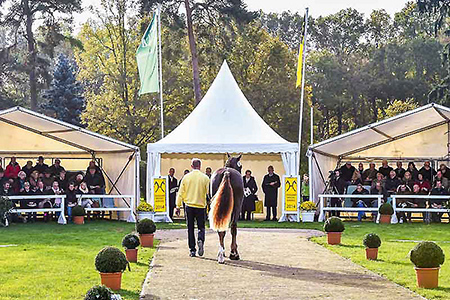
Looking at the Licensings of five leading studbooks – Hanoverian, Oldenburg, Westfalien, Danish and Dutch -, I found that of the five, only the colts at the KWPN approvals were distinctly Dutch. The rest showed that the breeders were more interested in producing foals to meet the market, the pedigrees clearly show that studbook loyalty was a thing of the past, whether Xavier and Astrid, or for that matter, Christopher, like it or not, the pedigrees reveal in each case a hefty infusion (should that be transfusion?) of blood from other books.
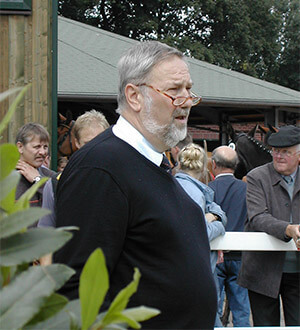
When Dr Roland Ramsauer died in October 2024, we lost one of the world’s great experts on sporthorse breeding, which is not surprising since he literally wrote the book: Das Oldenburger Sportpferd. Even though Roland was for many years one of the classifiers for the Oldenburg Verband, he was not a devoted follower of the breed, in fact he told he told me back in 2017 that he was looking to the day when all the breed associations merged into one German Sporthorse book…
“Of course, when I started thirty years ago, the breeder would ask, oh what breed is the stallion? Today nobody asks. They all ask what is the stallion producing? They don’t care if he has a Bavarian brand or an Oldenburg brand, or Netherlands or Holsteiner brand.”
Is there still an Oldenburg horse, or do we just have a German sporthorse – with the possible exception of Holstein and the Trakehners?
“That’s exactly right. We have a German Sporthorse. Already in the south, the associations are working together, and they don’t say Brandenburg or Bavarian or Bad-Württemberger, they call it the German Sporthorse. In the north it is a little bit different, still Oldenburg or Hanoverian or Westfalien, but anyway, the customers who will breed and buy horses, don’t look at the brand, only the pedigree. If the pedigree is good, he buys the horse, for showjumping, or dressage, or whatever.”
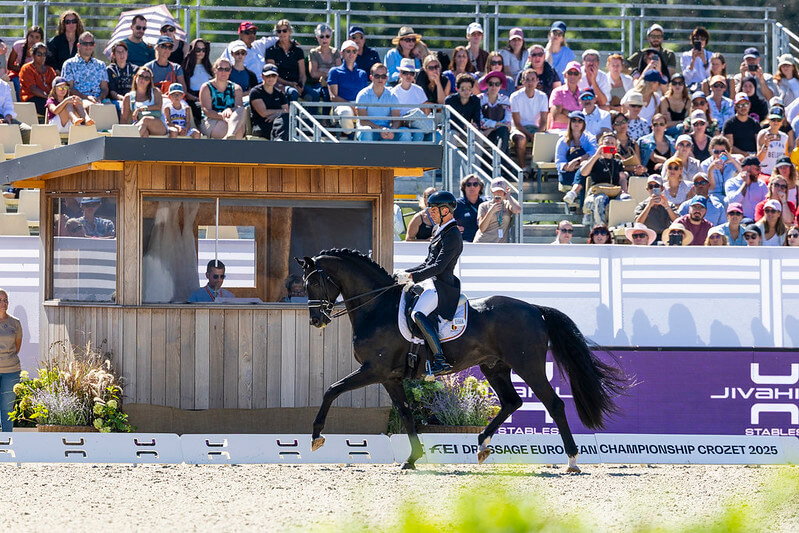
Zonik Plus
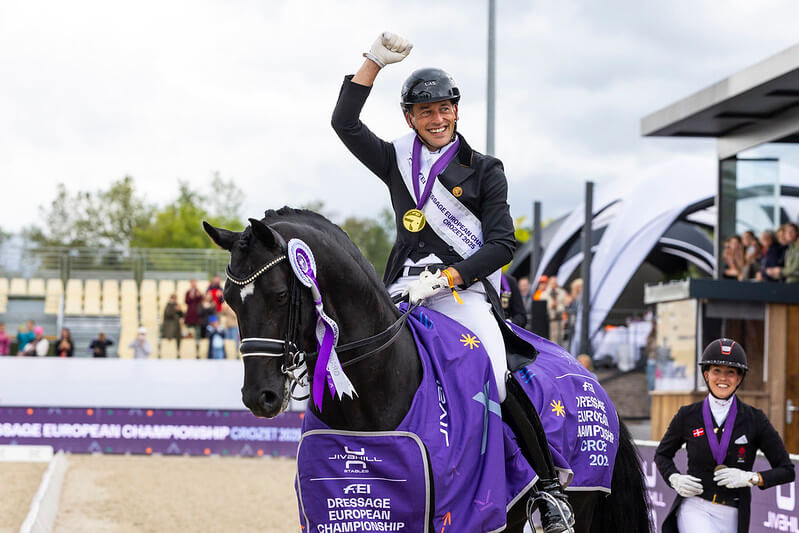
Let’s look at the new dressage sensation, European Gold Medallist, Zonik Plus. The stallion is described as Hanoverian, although he was bred in Portugal.
His sire, Zonik, is solidly Dutch bred (yes, two of the foundation sires of Dutch breeding, Ferro and Jazz grace his pedigree) on the third line of his pedigree, the only outsider, is the Westfalien, Roemer. Zonik Plus’ dam, Romanik is branded Danish Warmblood, though she is a familiar mix of Oldenburger and Hanoverian blood.

Zonik with Edward Gal at the WEG
Zonik Plus is out of Heideblume, by one of my favourite stallions, the black Trakehner, Hohenstein, out of a Donnerhall mare. Looking at the papers, it would be hard to tell which breed association he belongs to.

Hohenstein
The Silver Medallist was Freestyle, I really would rather not use the prefix, Mt St John, since the British stud had nothing to do with her breeding. Presented by her breeder, Stephan Kurz, the mare was purchased at the Hanoverian Elite Foal auction. In this case we have a horse that is really much as she is labelled, Hanoverian, although there were substantial contributions from Hanover’s near neighbours, Westfalia and Oldenburg.
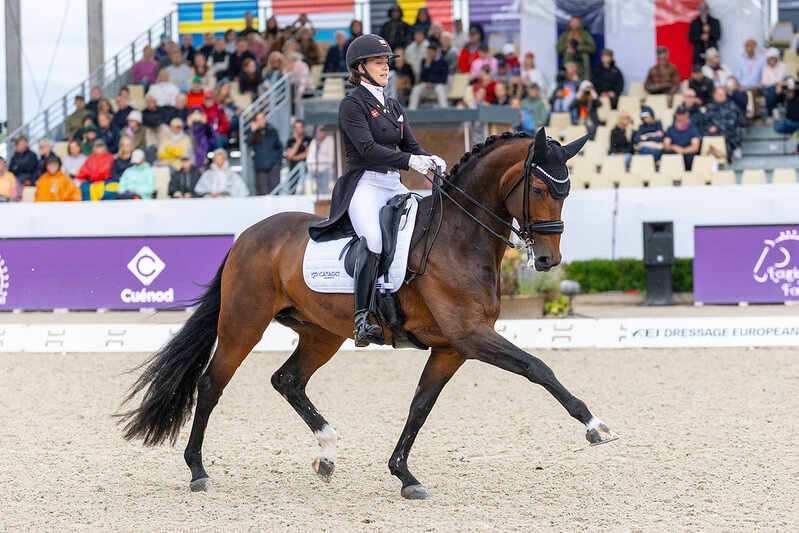
Freestyle and Cathrine Laudrup Dufour
Just when my argument was looking a trifle shaky, to my rescue comes the Bronze Medallist, Wendy de Fontaine, though I am reluctant to use the suffix, since the black mare was named Greenparks Wendy by her Danish breeder, Kurt Gosmer. Wendy boasts the blood of five breed associations in her veins: Danish, Oldenburg, KWPN, Hanoverian, and Holsteiner (!) Her sire, Sezuan is by Zack out of a Don Schufro mare.
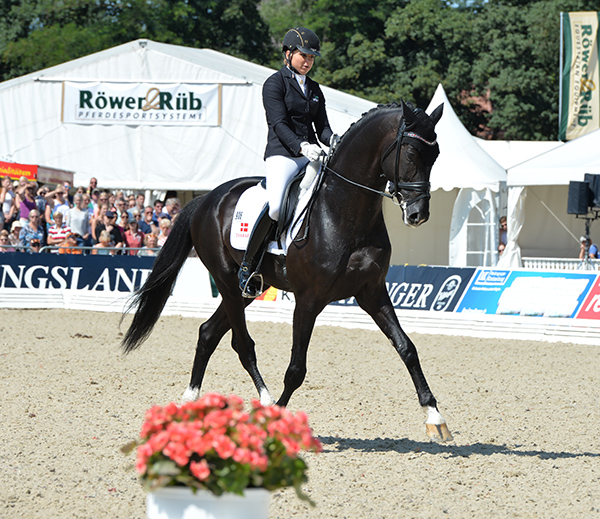
Sezuan, a winner as a young stallion, and Dorothee Schneider
Although now gelded, Sezuan has proven a very good sire, his stallion sons include Secret, So Unique, Santiano and So Perfect. You might have thought that a nice quiet old gelding could have been found for his owner to potter around on, leaving the black stallion entire.
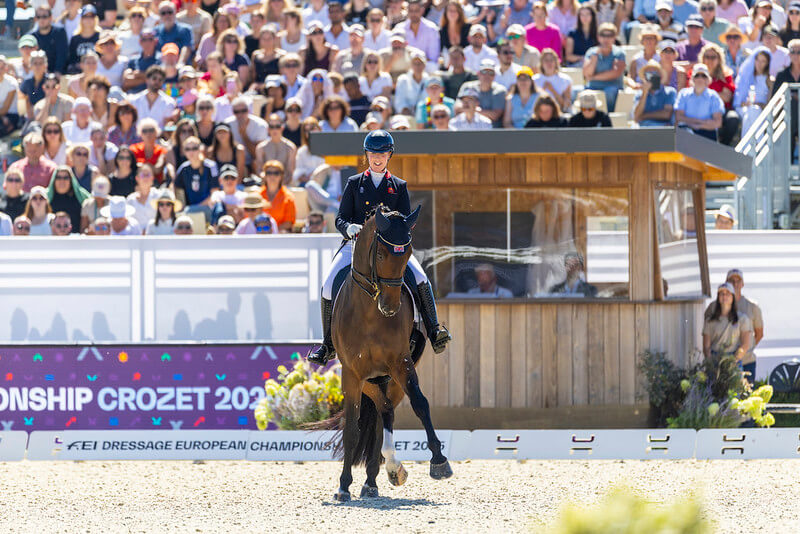
Jagerbomb – surely there should be a special prize for the highest ranking Homebred…
Jagerbomb who came in fourth, ridden by Becky Moody is another interesting mix, and even better, he is actually home bred, by Becky and her family. He is by Dante Weltino, Oldenburger branded, but by the Hanoverian son of De Niro, Danone I.

Dante Weltino competing at Aachen
There is even a good dash of Thoroughbred in Jagerbomb’s veins, since Dante Weltino’s grand-dam Riconess is by Noble Roi xx who was approved for the Hanoverian, Trakehner, Oldenburg and Holsteiner books. To find Jagerbomb’s dam line, we have to travel from Lower Saxony to the Low Countries, since Jagerbomb’s dam Udysee is solidly Dutch and comes from the time when there was no clear separation between jumping and dressage lines. Udysee is by Jazz but her dam is a grand-daughter of Ramiro, with three more 1.60m jumpers, Jasper, Emillion and Wellington making their contribution.
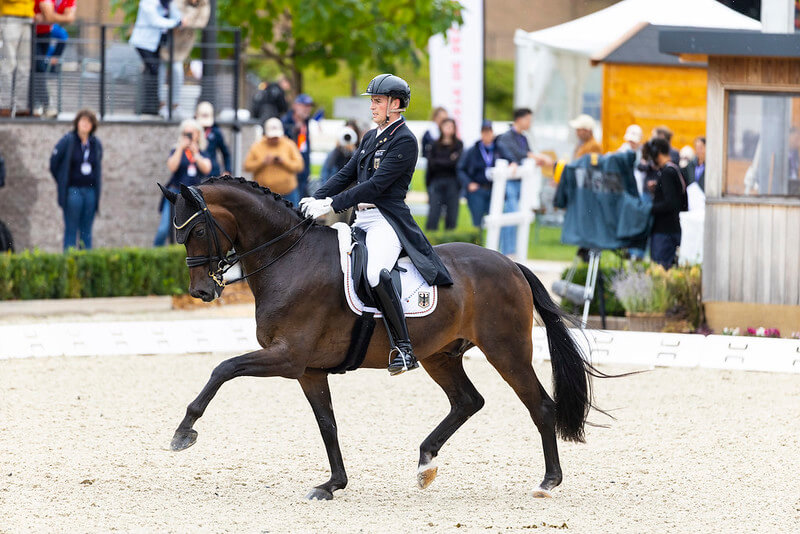
Bluetooth
Let’s finish with the fifth placegetter, Bluetooth, since he is another who shows that the sporthorses of today are most often an amalgam of blood from a number of books. Bluetooth is by Bordeaux, a son of one of the stars of Dutch breeding, United, by another brilliant one, Krack C.
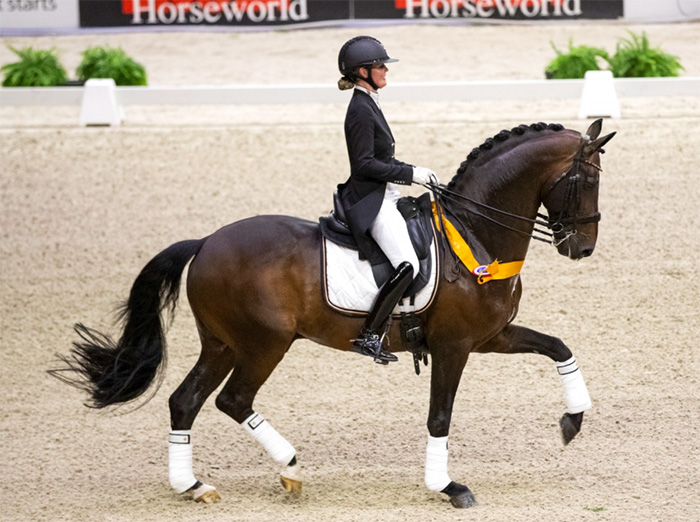
Bordeaux is out of a mare by the Trakehner stallion Gribaldi. Curiously the Dutch breeders seem to have made better use of Trakehner blood than the breeders in Germany, where the Trakehner originated.
Bluetooth is out of the Hanoverian mare Lorena by the Rubinstein son Riccione another with a Hanoverian brand. But to emphasise how arbitrary these labels are – Rubinstein was thoroughly Westfalien bred, but when he was rejected by the Westfalien commission, he was sold to the prominent Oldenburg breeder, Gudula Vorwerk and welcomed by the Oldenburger Verband. Lorena’s dam, Loreana is by one of the greats, the Oldenburger, Don Schufro, who in fact was four eighths Hanoverian, one eighth Trakehner, and one eighth, Westfalien.
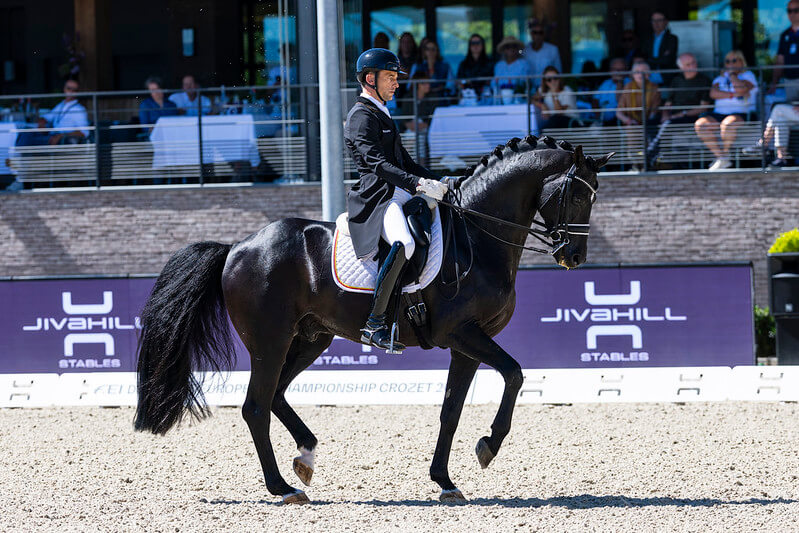
The New European Champion, Zonik Plus
Right now there are serious predictions that the ‘breeds’ will merge into one German Riding horse book. this would cause a degree of lamentation over a schnapps or three, but will the horses themselves be any different? I don’t think so…