


Contact or no contact, that is the question. Or is it? I do not think it is…
– by Dr H. L. M. van Schaik
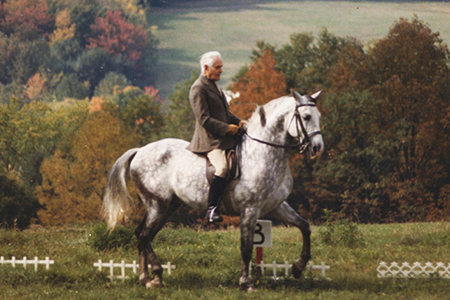
When we pursue the schooling of a horse from the very beginning to the highest level, ‘Artistic Equitation’, then we will understand that during this endeavour, there are different graduations in the amount of contact the rider has with the horse.
I think it is very dangerous to speak about ‘no contact’ when those who we address have very little experience. I hope that the following example will make this clear. In the mid-fifties and early sixties, a Russian immigrant by the name of Littauer had a very large following in the United States. Most horses were ridden in Kimberwicks; the riders had offset stirrups; and in the first few months of instruction, the riders were not supposed to have contact.
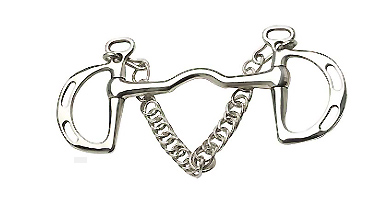
The Kimberwick/Kimblewick bit

Offset stirrups irons – purpose of the design is to aid correct leg position
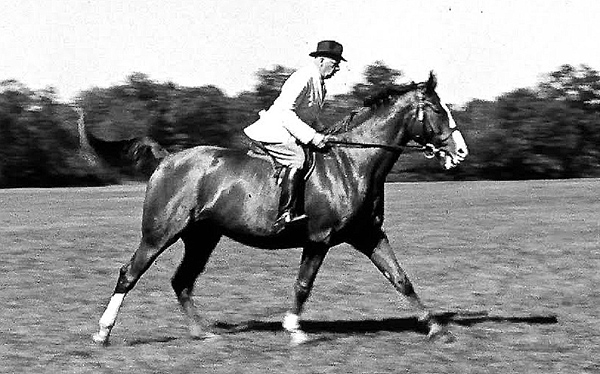
Vladimir Littauer in the saddle
In the early sixties, some girls came to my school to have instruction. The youngest one had a good-looking mare. The trouble was that during the lesson, the horse, ridden without contact, would pass all the other horses.
Since the girl did not react to my directions on how to achieve control of her horse, I asked if I could mount the horse so that I could show her what I meant. There was no problem whatsoever with the horse; I had light, elastic contact, and had no difficulties in slowing the horse down. After I had dismounted, I said to the girl: ‘You see, there is nothing to it.’ The girl burst into tears and while sobbing cried: ‘But I do not think it was very pleasant for the horse.’
This girl had the totally misguided idea of not having contact. Green horses should be helped to accept the bit after having been accustomed to the snaffle on the lunge line. The rider should try to achieve very light and elastic contact. The young horse should never have the feeling of being constrained. Constraint would not only cause resistances, but also would impede the forward movement of the horse, especially in the walk.
In this context it may be appropriate to point to two confusing expressions. The first one is ‘La descente de main’ (Loosening of all contact with the hand, without the horse changing frame). This is an invention of Baucher.
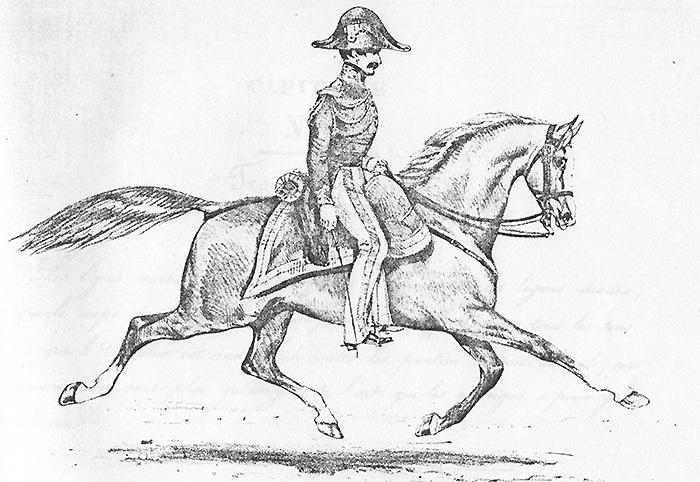
Since Baucher put great emphasis on head and neck position, he consequently used his hands a lot. By practising la descente de main for a short time, he eliminated the pressure on the bit. Because we believe that the elevation of the forehand is the result of the engagement of the hindquarters, and since we emphasize the elasticity of rein contact, we do not believe in practising this movement.
The second confusing expression is ‘Das Uberstreichen’ (rubbing the hands upwards on the neck in order to get the horse to stretch the neck).
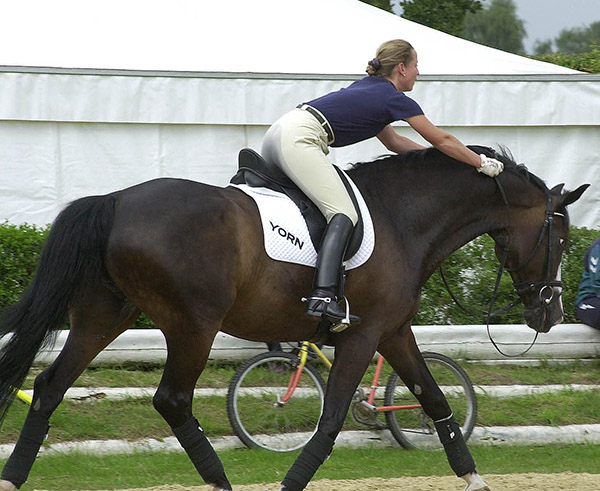
For more on Descente de Main and Uberstreichen – go to: https://www.horsemagazine.com/thm/2021/08/miguel-tavora-the-difference-between-uberstreichen-and-descente-de-main/
There was a time when the Germans used to ride their horses in a rather short frame. The result was that the horse did not decontract when there was no rein pressure, so the riders tried to push the horses’ heads down.
If one rides with elastic contact, following the movement of the horse, every horse will stretch the neck and de-contract the moment that the rider opens the hands and lets the reins slide through the fingers (this is not quite the equivalent of the German aus der Hand kauen lassen). This sliding can of course only happen with flat, smooth reins.
Why do we want contact? Because we want the horse to improve the lateral flexibility. In other words, because we want the horse to become permeable (French: perméable, German: durchlässing). This means that the horse lets the impulsion, created by the driving aids of the rider, go from the hindquarters through the back and neck muscles, causing flexion of the poll, and causing the horse to accept the bit, without stiffening of the jaw. The acceptance of the bit means that the driving aids and the guiding aids have met. At this point the process reverses itself: the guiding aids regulating the impulsion, taking care of the longitudinal and the lateral flexions and also of the different gaits and movements.
I hope that the reader will understand that the above is strictly of Classical Equitation. Other equitations such as Western have totally different objectives. Because the Western rider has to have his hands free for roping, he does not want his horse to accept the bit. He is not interested in longitudinal or lateral flexions. He neck reins and makes sliding halts by putting on the hand brake. By using very sharp bits he achieves this goal.
One of the most important and most difficult things in classical equitation is to have elastic contact. I think that the question is not contact or no contact, but the quality of the contact.
Therefore I believe that as soon as the beginner rider has found some balance on the horse while being lunged, he should right away be instructed how to develop an elastic contact. In the first place, he should learn not to use his arm muscles, but his back muscles. Furthermore, he should develop an elastic contact by never having a stretched elbow joint but a flexible one which opens and closes. The best way to teach this is on a horse that has a good walk. The rider, while keeping the reins all the time straight with a light contact, should learn to follow the movements of the horse’s head. A horse will fight the rider’s hand if constrained by the rider using his arm muscles and by not having elastic contact. As I put it, the rider puts on the hand brake.
During the schooling period, in which we want the horse to come under with the hindquarter, there will be times that we need to apply a lot of contact. At this time the horse has to learn that when we create more impulsion and increase the resistance, the horse should not try to go faster and become longer, but he should try to get is hindquarters under.
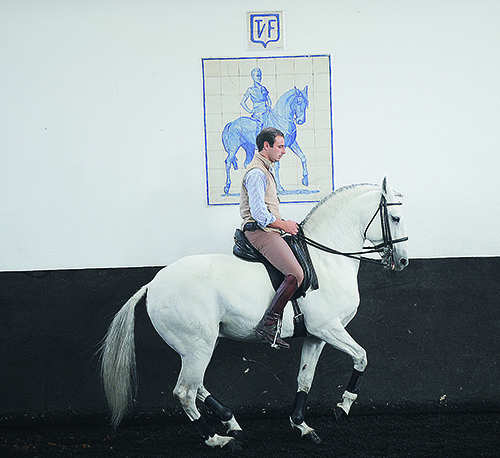
Once the horse has learned to do this, he will carry himself. The more he carries himself, the more he understands what the rider wants from him, the lighter the contact will become.
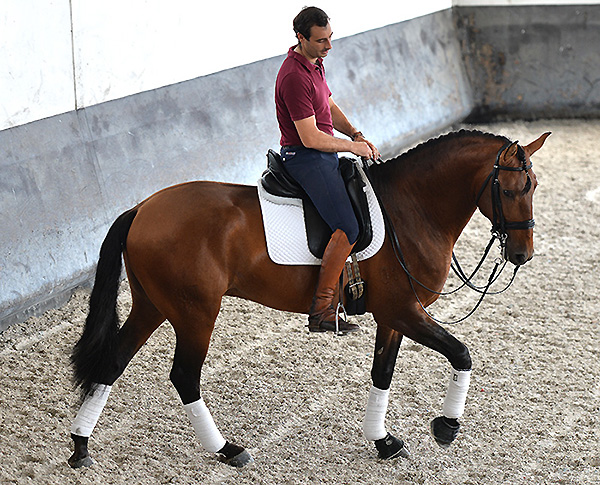
No contact at the end is an ideal that only very few people attain. I have known perhaps five people who have achieved this unity with the horse. It is distressing to say, but I have never seen it in competitions, not even in Grand Prix, or in the Kür.
Dr H.L.M. Van Schaik
1899-1991
Henri van Schaik was born in Holland and began his riding career as a showjumper, winning team silver at the Berlin Olympics on Santa Bell.
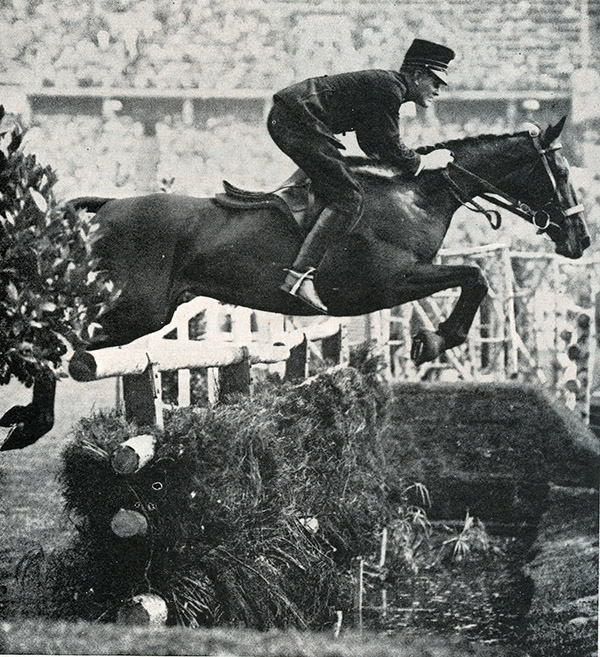
Henri van Schaik riding Santa Bell at the 1936 Games
He migrated to the United States after WW2, and opened a riding academy in Vermont. He was much in demand as a trainer and a judge, as respected as a rider who trained in the classical manner.
Throughout the 60’s, 70’s and 80’s, he was one of a number of riders who became concerned that the classical principles were increasingly under threat from the emerging style of competition dressage.
His book, Misconceptions and Simple Truths in Dressage began as a series of articles defending the classical way of training. Writing in Dressage & CT, after the World Dressage Championships in Canada, he was withering:
These last World Championships made it very clear that the judges totally neglect the artistic. This was also evident in the judging of the Kür. I am convinced this is the reason why classical equitation is practically dead. It was expressed very well by somebody sitting in my neighborhood: ‘The quality of the horses is getting better and better, but the level of riding is going consistently down.’
I saw only two horses who made the impression of doing of their own accord what was required of them. Their riders, although not very good ones, both had very soft hands. It all made an effortless impression, both riders and horses enjoying themselves. They were, of course, very low in ratings.
High in the ratings were riders with very active hands, interfering almost every stride. One of the riders during the Grand Prix Freestyle, used her hands as the conductor of an orchestra does. Every beat of the music brought her hands up.
Some riders were very mobile with their bodies especially in the extended canter. I cannot understand why the judges do not do anything about it. This way of riding is a mockery of classical equitation and against the rules.
The reason that so many people have trouble with their hands is that they use the wrong muscles. The contact with the horse’s mouth should be elastic. This can only be achieved if the rider flexes the elbow, never riding with stretched elbows, and also if he does not use the arm muscles, with the exception of the triceps. The rider should be able to balance the hand, which he cannot do if he uses his biceps or lower arm muscles.
The rider should resist with his back muscles. Before the Second World War, people were taught to ride with their back, not only to create impulsion but also to resist. Nowadays, most people pull with their arms, often brace their hands and they try to create impulsion with their heels and spurs. Their legs are all over the place, most of the time.”
Publications:
Misconceptions and Simple Truths in Dressage (1986)