

Analysis by Christopher Hector
This year the KWPN once again topped the ranking with 13.375 points.
The top six horses contributing to this winning spot are:

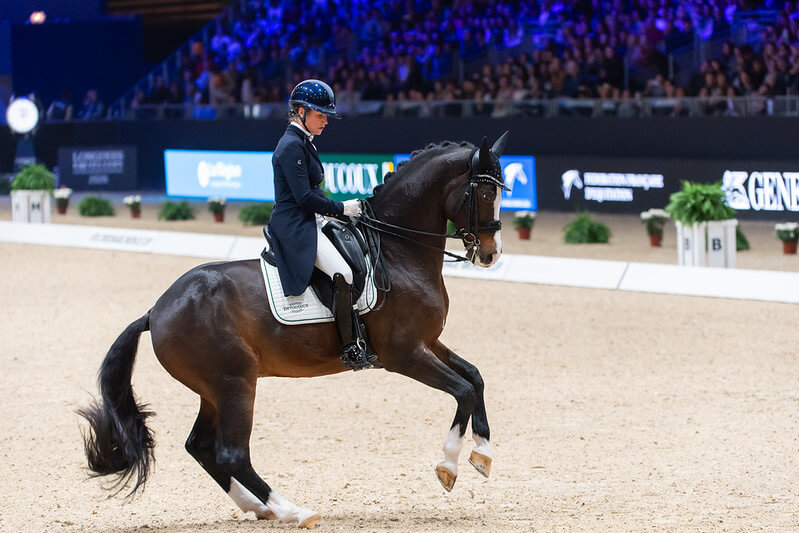
- Glamourdale (by Lord Leatherdale)
- Jagerbomb (by Dante Weltino)
- Fame (by Bordeaux)
- Flambeau (by Ampere)
- Indian Rock (by Apache)
- Great Escape Camelot (by Johnson)
The second placed studbook is Oldenburg, just like last year, with 12,893 points. Their top six contributing horses are:
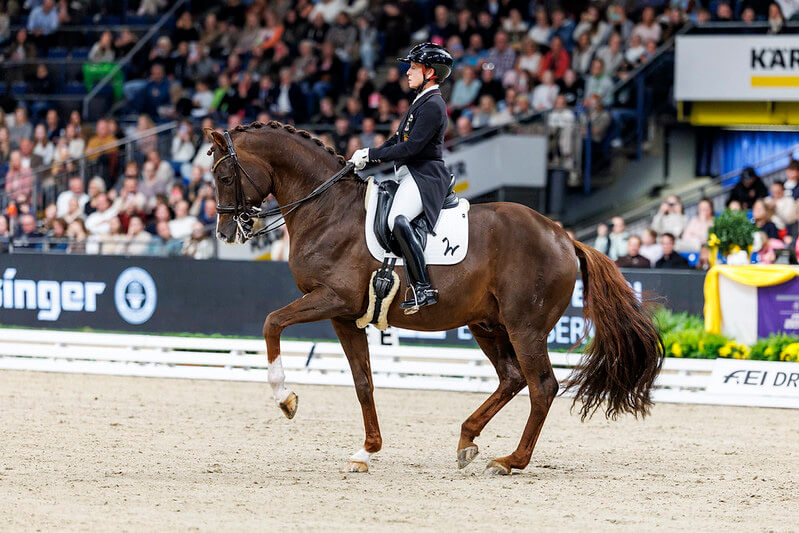
- Viva Gold (by Vivaldi)
- Zantana (by Zonik)
- Denoix (by Destano)
- Maxima Bella (by Millennium)
- Bluetooth (by Bordeaux)
- Total Hope (by Totilas)
The third ranked studbook is the Hanoverian Society with 11,596 points. They were also third in 2025. Their six best horses are:
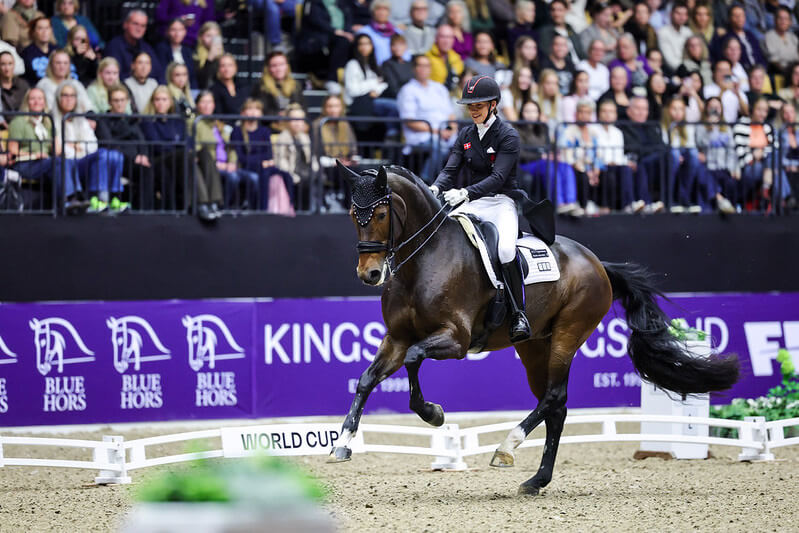
- Freestyle (by Fidermark)
- Navarro (by Negro)
- Quick Decision (by Quaterhall)
- QuincyB by Quaterback)
- First Class (by Fürstenball)
- Amanyara M (by Ampere)
- Danish warmblood is fourth (10,509 points) and the Lusitano studbook climbed to fifth place, its highest ranking ever, with 9,419 points. Contributing Lusitanos are Gladiador Do Lis, Marques Dos Cedros, Lirio MVL, Irao , Jairo D Alem, and Come Back De Massa.
Christopher Hector takes a look behind the numbers
I can still remember a time when the German dressage breeders had a somewhat patronising attitude as dressage breeding in Holland struggled into being. The Dutch may well breed wonderful jumpers they said, but if you want dressage you had to come to Germany, particularly Hanover. How times have changed, this year for the tenth time in a row, the KWPN claimed number one spot on the WBFSH dressage studbook rankings, with the Hanoverian book in third with two of the six that contributed to their points total by Dutch stallions.
How did the Dutch do it? First by adopting the same strategy with their dressage stallions as they did for jumping. While the stallions in Hanover were almost entirely owned by the Verband and stood at the State Stud Celle for a modest fee, the Dutch stallion keepers could set their own fees and attract and keep the best of the best.
More importantly while the German books still clung to the breeding goal of the all-round horse, the Dutch very early saw the writing on the wall, and split their breeding program into a jumping stream and a dressage stream. It started in 1990 with the two tendencies recognised in the stallion testings and became official policy in 2005.
Not surprisingly the Dutch team is headed by world champion Glamourdale (Lord Leatherdale / Negro), the product of the thoughtful breeding program of Gert-Jan van Olst, in this case going to Germany to find Lord Leatherdale (Lord Loxley / Ferragamo) a lighter more refined stallion to cross over mares from his foundation sire, Negro (Ferro / Variant).

Anne van-Olst and Lord Leatherdale
Gert told me: “In Holland we had many sons and daughters of Jazz and Krack and their lines, so we needed new blood, that’s why we bought Lord Leatherdale. The other reason was that I thought his good things were fitting quite well on the good things of Negro. We had a lot of Negro mares, and he was a nice stallion to combine with the Negro mares. Lord Leatherdale gives a lot of looseness, and a lot of presence and a lot of front. Those things he brings very well to the Negro mares, they are mostly a little bit more closed, having a lot of power and missing a little bit of suppleness when it comes to the lateral movements. The strong things of Negro are very nice combined with Lord Leatherdale, and it has been a successful combination: Chippendale, Everdale, we have Fairytale, we have Glamourdale, all from this combination.”
How the stallion became named after American Hanoverian breeders, Doug and Louise Leatherdale is something of a mystery. I once asked Jens Meyer who stood the Leatherdale stallions, and he went vague, ‘it was something to do when I was doing some business with Van-Olst…’

Jagerbomb and Becky Moody, who also bred the gelding
The second highest Dutch points scorer Jagerbomb is also by a German stallion, Dante Weltino, whose sire De Niro by Donnerhall, is one of the real stars of dressage breeding. De Niro was a stallion that the head of the Hanoverian state stud at Celle had the opportunity to select at the licensing as one of the ten stallions Celle had first option on in those days, but seemingly because Dr Bade was intent on promoting the Hanoverian home-grown product, Weltmeyer and not the progeny of Donnerhall from just across the border in Oldenburg, he didn’t take the option on De Niro, and somewhat to his surprise, master breeder, Burchard Wahler found himself in possession of the colt.
Although there are two crosses of Weltmeyer on Dante Weltino’s pedigree, Weltmeyer was not a success at stud. Despite covering 200 of Hanover’s finest mares in his first season when he stayed at the State Stud instead of being sent to one of the little local stations and taking his chances with the mares from that district, which had been the case with every other stallion in the past Weltmeyer, the stallion did not produce performers.

Carl Hester and Fame
?The rest of the KWPN contingent are by very Dutch, Fame by Bordeaux, Flambeau by Ampere, Indian Rock by Apache, Great Escape Camelot by Johnson.
The magnificent Indian Rock, who is currently starring in the United States,reminds us of the ludicrous WFFS farce, since his sire Apache’s stud career was limited when he was revealed to be, like his son, WFFS positive.

Indian Rock
Oldenburg comes in third on the standings, they too benefited by having a relatively open studbook, and also the breeding triumph that was the Schockemöhle brothers. The first born Alwin was not only a great jumping rider, but also a breeder, while the second brother Werner was a wonderful student of the sport horse and the author of three books on breeding.
He told me: “Normally a horse will be as good as the breeder’s ambition. It sounds a little crazy, but think a little longer about it. When the breeders try hard enough to come to the highest aim, then it is possible to reach it – that is the history of breeding all sorts of animals. You can breed what you wish, you must be clever enough, tough enough, strong enough, good enough to do it without fear of the consequences, then it is possible. But people are too lazy in the brain, they say ‘we can only breed dressage horses’ or ‘we can only breed jumping horses’. That’s wrong.”

The third brother Paul is the most important of all and has revolutionised Sporthorse breeding in so many ways. He needs a book devoted entirely to him.
The stallions that have contributed to the Oldenburg points score show just how widely their breeders have been prepared to look and how clever their selections have been: Holland, Hanover, Trakehner, Holland, Trakehner.

Vivaldi
Their number one, Viva Gold, represents the most successful line of recent years, the V line of Vivaldi. The stallion’s pedigree is pretty well a history of the development of dressage in The Netherlands: Krack C, Jazz, Ulft, though the breeding wizard who made him famous, Eugéne Reesink, admits that he is a little puzzled as to where Vivaldi and his sons’ legendary temperament comes from. “It’s funny because if you see the breeding of Vivaldi, it’s Krack C, Jazz so you expect…” Crazy “And yet they are so easy, so nice to ride, it starts with Vivaldi, I am sure of that. ”
In third spot we find the Hanoverian Verband and it is some measure of their inability to produce sires, that not one of their team is by a stallion from the Hanoverian breeding program.
Most Hanoverian points came from the fabulous Freestyle (Fidermark / Donnerhall) who for the second year running won her German breeder, Stephan Kurz, the WBFSH breeder of the year title, hopefully that means we can drop the prefix Mt St John since the British stud had nothing to do with the mare’s breeding.

Quaterback
There are two whose origins lie in the east at Neustadt-Dosse where they bred Quaterback out of one of their famed mare lines, while his son Quaterhall out of a Donnerhall mare, also. contributed to the Hanoverian total. Fourth highest was First Class by Fürstenball this time out of a Hanoverian mare by Bergamon.
The fifth member of the Hanoverian team is by Ampère, notable as he is the only stallion represented by more than one of his get in the rankings. Perhaps because of his slightly erratic career, from Holland to Sweden to the United States, Ampère has been slightly neglected. His sire Rousseau has been one of the more important disseminators of the blood of the great Ferro, while his dam side is solidly Dutch – Flemmingh / Amor. Ampère is the sire of 68 stallion sons and 49 Grand Prix competitors.

Ampère
Ampère is also a wonderful example of how the Dutch have taken jumping lines – mainly from Holstein – and forged a new style of dressage specialist. Consider the fourth line of Ampère’s pedigree, the Selle Français Le Mexico, the Holsteiner Farn (twice), the foundation sire of the modern Westfalien jumpers Pilatus (sire of Pilot and Polydor), another Holstein great, Landgraf, and the Cor de la Bryère son Carneval. In the third line we find another of the Holsteiners that shaped the Dutch Warmblood, Amor.
It is, then, something of a triumph of breeding that such a mix should produce such a refined, modern type of horse and in the process transform the emphasis from jumping to dressage.
Ampère is by Rousseau, another multi-national. He too was born in Holland in 1998, but since 2006, has stood in the United States, after two seasons at the famed German stallion station of the family Pape.
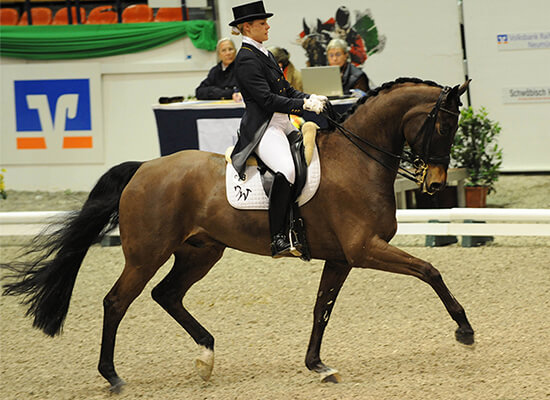
Rousseau
Rousseau is by Ferro, an international dressage competitor, and out of a mare by Roemer, another stallion exported to America, where after a jumping career in The Netherlands, he morphed into a Grand Prix dressage horse.
Ampère adds to the mix two more of the golden threads of Dutch dressage breeding: Flemmingh and Amor.
When the famous Dutch breeder, Wiepke van der Lageweg purchased Flemmingh as a colt in Holstein, I am sure he had jumping on his mind, certainly that is what his pedigree would indicate, and sure enough at the performance test in Holland, one of Flemmingh’s three scores of 9, was for jumping, and when he was advertised in the 1992/93 edition of The Leading Sires of The Netherlands, he was pictured over a jump. But it turned out that his progeny excelled in the dressage arena, and Flemmingh became one of the most important of the early dressage sires in Holland.
Two of Flemmingh’s stallion sons – Krack C and Lingh – were members of the Dutch dressage team, and his qualities as a dressage sire were even recognised in Germany where, in 2009, his son Fairbanks, was champion of the Oldenburg licensing, and sold to American Hanoverian breeder, Doug Leatherdale for a sale-topping price of €250,000 to stand at Hengststation Meyer.

Amor
Ampère’s dam is a grand-daughter of Amor who was imported from Holstein at the age of three. Since Amor lived from 1959 to 1990, he was enormously influential, and Dutch pedigrees are dotted with his name, often several times on the same pedigree. The famous Dutch breeder, Huub van Helvoirt, based his breeding program on two Amor mares – producing amongst others, the great sire, Jazz, on this mare base.
Ampère’s first crop produced five sons who were selected for the KWPN Stallion licensing in 2012 and they were a lovely line of horses – really stamped with the mark of their sire. Three of the Ampères were approved for performance testing, with Excalibur out of a De Niro into the championship.
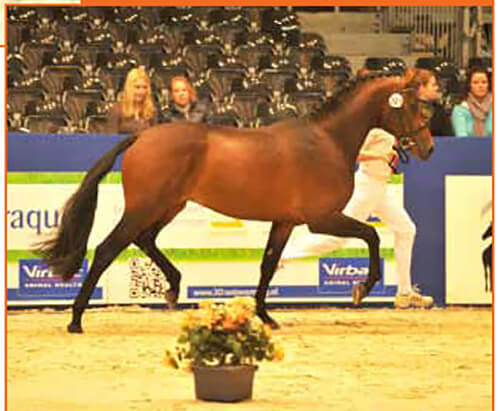
Ampère/Fidermark at the stallion show…
Currently Ampère is being wonderfully represented by Larissa Pauluis and his son Flambeau (out of a Zeoliet mare) second to Isabel Werth and Viva Gold at the Stuttgart World Cup on a score of 82.555