



Part 1 – by Paul Belasik

There is a new Grand Prix dressage test upcoming and to me, the choreography defies comprehension. Toward the very end of the test after a challenging series of movements and right before the final extended trot, the rider is asked to trot and release the reins, lowering the horse’s neck on a 20 meter circle, putting the horse heavily on the forehand in a “stretching circle.” Then very quickly, in a matter of seconds, the rider must pick the horse up to try to get it back in balance and extend the trot. We are not talking about a release of one rein or even two reins for a couple of strides to prove the horse is not heavily balancing on the reins, which seems much more sensible.
No, this is a lowering of the neck as in the old cavalry training. I have written about this extensively in my latest book “Long and Low: A Revolution in Modern Dressage.” I don’t know how much science it will take for the long and low disciples to understand that when the horse forms this posture, it is increasing the weight on the front end and lightening the rear. It is physically impossible to maintain a state of equilibrium over four legs. By definition, you are overburdening an already naturally overburdened forehand. If the neck curls in at all, the horse is not just taking a relaxing rest, it is simply using different muscles on the underside of the neck. It is still effortful.
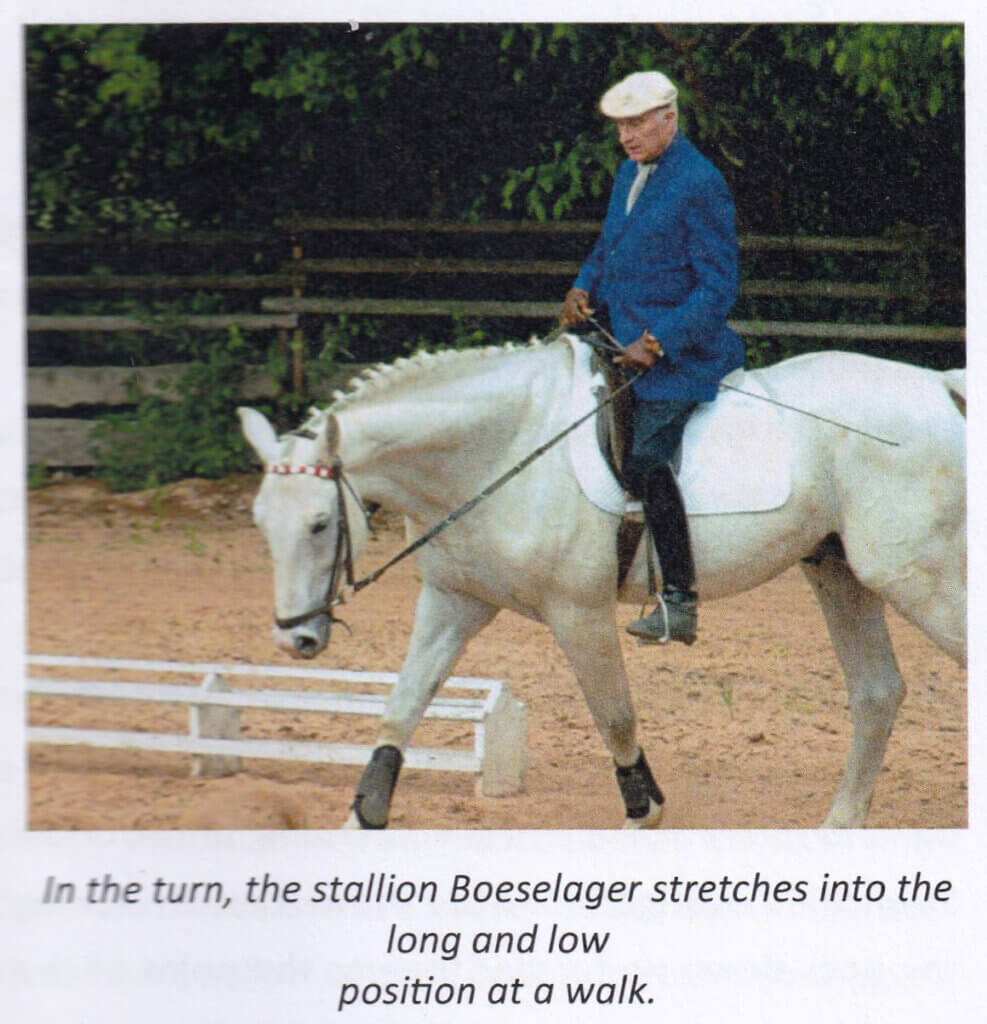
Photo credit: Gert Schwabl von Gordon (last surviving member of of the School of Hanover and proponent of long and low riding), from his book “Classical Dressage Training in Practice according to the H.Dv.12”. Trans. Elisabeth D’Antoni
If you want to see a good example of a release of tension, then watch 99.9% of horses and riders after the final salute. They pat the horse, let go of the reins, and sometimes under thunderous applause, walk out of the competition arena, almost always calmly. The reins are loose, the horse stretches out. If they don’t, you might get suspicious of their state of mind, if nervousness was built into their training.
Let’s shift Grand Prix’s for a minute and go to a Grand Prix jumping event. Imagine we are following the horse and rider through various combinations and turning lines, jumping, collecting, lengthening. People are on the edge of their seats. The last fence is a substantial oxer, which will take considerable effort. But just before the oxer, the rider has to turn onto a 20 meter circle, drop to a rising trot and release the reins, lowering the neck. Then in a matter of seconds, pick up the reins and neck and jump the oxer. How about if we were watching an ice-skating performance? The skater or skaters are building to a crescendo and then at the last moment they slow down and perform a simple circle, like the old compulsory figures, and then back to the grand finale. From the point of marketability, this is insane. What will the audience’s reaction to this choreography be? Dressage is already fighting a reputation for being boring.
What about examining this stretch circle in the Grand Prix dressage test from the point of view of testing or training? In jumping course design, there is a fine line between a challenging combination and a trap. A trap would be an impossible distance or line, or it could be a line or distance which forces a well-trained horse and rider into bad technique. They are led into a place where the only way out may be a desperate Hail Mary effort. It feels dishonest to the horse and rider, as if you tried to trick them, not to challenge their best technique, but to see which horses will find a way out.
The dressage choreography of a long and low circle with a stretch in a Grand Prix test before the powerful trot extension is a trap. It will try to trick the horse into relaxing as if the test were over and then around the corner abruptly stands this oxer of an extended trot. It is borderline dangerous. If the judges don’t like heavy hands, they should stop rewarding overbent horses with 8’s and 9’s. Or, they could simply keep scoring as the riders exit the arena. After the final halt and salute, the rider releases the reins and walks out, and the relaxation is scored until they leave the ring.
I feel that this stretchy circle is kind of an insult to Grand Prix riders and horses, demanding they show some allegiance to a training regimen which has a controversial history and dubious results. By the time riders and horses are competing at the Grand Prix, they have undergone countless tests and qualifications to be able to ride at that level. They will present different styles: soft and elegant, strong, and athletic, conservative, careful, riskier – that is some of the fun. Trust yourself to see all the differences, let audiences have their own favorites. The most important rule is respect; respect of other riders and everyone respects the horse.
Competition dressage seems to be in the midst of an identity crisis right now. Is it a performance art where horse shows can be a stage or venue to see these performances? Is it a sport where there is a winner and there are clear rules how to win? Or is it an examination, where you will be tested on your knowledge and skill like a bar exam for a lawyer?
The new Grand Prix test cannot seem to make up its mind. What is prompting all this confusion? Where is it all coming from? We all know where. It is coming from rising animal welfare concerns. In my next article, I want to look at some of these concerns.