

The myth of ‘Classical’ Dressage
By Christopher Hector
Robert Dover is not only one of the most elegant of dressage riders, he is also one of the most thoughtful. In a recent post Robert set out to answer this question:
A lovely lady asked me today about my thoughts regarding critics who say we need to get back to the “classical riding of the past”. What is my opinion about the word, ‘classical’ in this context.
Now instead of mouthing the fashionable clichés Robert pointed out that some of those historical greats don’t look so good today:

Robert and Metallic at Atlanta
Is Classical from the time of Zenophon, or from fifteenth or sixteenth century trainers, all who are captured in paintings we see today? In many of these pictures consider the bits, spurs, position of the whip and the horse’s head, and how we would judge such riding by our standards of today.

Fast forward to the master, Otto Lorke, who was the trainer of so many of the greats after him. He was famed for having trained horses to canter on three legs and also backwards. Look at photos of him riding and then think about how people would critique them today. One of the greatest Classical trainers of the last century once got so angry at his horse that he leaned forward in the saddle, grabbed the horse’s ear and twisted it until the horse dropped to his knees. Classical?
Thanks Robert, let’s go look:
Xenophon is of interest since he has a group of fanatical followers who go crazy at any criticism of the Greek general. When I pointed out that there was nothing of use to us today in his The Art of Horsemanship, one follower suggested that his more profound teachings on equestrianism were in his other writings; strange that he should not include his more profound thoughts on equestrianism in his book on the subject but, seemingly, gems are hidden somewhere, thoughts the followers cannot quote but believe are there. This is cult not rational thinking.

My feeling is that many enthusiasts have the idea that the Classical Principles were discovered, written perhaps like the ten commandments on tablets of stone, by Xenophon a couple of thousand years ago. For example, in Germany, the Professional Riders in response to the debate with the followers of the Anky and Sjef school, put out a pamphlet with the message – ‘We don’t want hyperflexion – we have had our principles for 2500 years’!
Which is simply not true. There is almost nothing in Xenophon that would help you train the modern dressage horse – or any other horse…..
I suspect the dressage enthusiasts who get the most inspiration from the ancient Greek military commander are the ones who have never actually attempted to read his little book. Or certainly that is the impression you get when hearing statements like, “All the wisdom you need to train a horse is to be found in the teachings of Xenophon.”

I am sure they have a vision of dear old Xenophon, togged out in the latest breeches and long boots, mounted on his handsome Hanoverian gelding, warming up long and low – but never ever behind the vertical! – with the latest saddle, and using the latest double-jointed snaffle as approved by Professor Clayton, working his way through medium/advanced in the direction of the FEI levels.
Let’s see what Xenophon really wrote:
There is only one schooling exercise to be found in Xenophon’s The Art of Horsemanship, which he calls ‘the Career’.
“I recommend the Career with sharp turns at each end rather than the complete Volte; for the horse would like turning better after he has had enough of the straight course, and thus would be practising straight-way running and turning at the same time.”
I guess barrel racers might find this helpful…
According to J. K. Anderson in the authoritative work on the subject Ancient Greek Horsemanship, Xenophon taught that the horse should lead with the left leg all the time and “does not appear to have practised changing the leading foot.” Xenophon also recommended teaching the horse to jump natural obstacles like ditches and logs.
Now to a paragraph that is much quoted, and more often misquoted, or improvedupon in the process:
“If you desire to handle a good war-horse so as to make his action the more magnificent and striking, you must refrain from pulling at his mouth with the bit as well as from spurring and whipping him. Most people think that this is the way to make him look fine; but they only produce an effect exactly contrary to what they desire, they positively blind their horses by jerking the mouth up instead of letting them look forward, and by spurring and striking scare them into disorder and danger. This is the way horses behave that are fretted by their riders into ugly and ungraceful action; but if you teach your horse to go with a light hand on the bit, and yet to hold his head well up and to arch his neck, you will be making him do just what the animal himself glories and delights in. A proof that he really delights in it is that when a horse is turned loose and runs off to join other horses, and especially towards mares, then he holds his head up as high as he can, arches his neck in the most spirited style, lifts his legs with free action, and raises his tail. So when he is induced by a man to assume all the airs and graces which he puts on himself when he is showing off voluntarily, the result is a horse that likes to be ridden, that presents a magnificent sight, that looks alert, that is the observed of all observers.”
According to Professor Anderson the Greek horse at the time of Xenophon was “a small animal, perhaps never exceeding, and seldom reaching, fifteen hands, with a fine head and legs, high head carriage, and rather heavy body.”
Xenophon recommends strewing stones in the horse’s enclosure to strengthen its hooves, in particular its frog. After 24 pages of very general horse care instructions we do find a little nugget of gold:
“The one great precept and practice in using a horse is this – never deal with him when you are in a fit of passion. A fit of passion is a thing that has no foresight in it, and so we often have to rue the day when we gave way to it. Consequently, when your horse shies at an object and is unwilling to go up to it, he should be shown that there is nothing fearful in it, least of all to a courageous horse like him; but if this fails, touch the object yourself that seems so dreadful to him, and lead him up to it with gentleness. Compulsion and blows inspire only the more fear; for when horses are at all hurt at such a time, they think that what they shied at, is the cause of the hurt.”
Andrew McLean might have some rather better advice for dealing with shying and could explain to dear old Xenophon that horses do not have the kind of reasoning powers that allow them to learn by example as he suggests, but the general principle of not beating the tripe out of your neddy because you are in a bad mood, is worth repeating over and over again, and might have saved several high-profile riders much embarrassment of late.
And there is another training exercise to be found in the work:
“When it comes to his riding in a proud and stately style, in the first part of his training we accustomed him, you remember to dash forward at full speed after making the turns. Well, after he has learned this, if you support him by the bit and at the same moment give him one of the signs to dash forward, the bit holds him in and the signal to advance rouses him up. He will then throw out his chest and raise his legs rather high, and furiously though not flexibly; for horses do not use their legs very flexibly when they are being hurt. Now if, when his fire is thus kindled, you let him have the bit, the slackness of it makes him think that he is given his head, and in his joy, he will bound along with proud gait and prancing legs, imitating exactly the airs that he puts on before other horses. Everybody that sees such a horse cries out that he is free, willing, fit to ride, high-mettled, brilliant, and at once beautiful and fiery in appearance.”
Xenophon notes that the best horses for this work were those with supple loins: “Such a horse will be able to gather the hind legs well in under the fore (this is to perform the demi-passade). Now when he has gathered them well in, if you take him up with the bit, he falls back on his hocks and raises his forehand so that his belly and sheath can be seen from the front. You must give him the bit when he does this, and it will look to the spectators as if he were doing all of his own accord the prettiest feat that a horse can do. There are, to be sure, some persons who teach this movement either by tapping the hocks with a rod, or by directing somebody to run along by the side and strike him with a stick under the gaskins. But for my part, I think, as I have said all along, that it is the best of lessons if the horse gets a session of repose whenever he has behaved to his rider’s satisfaction.”
Then comes the most quoted lines of them all:
“For what the horse does under compulsion… is done without understanding; and there is no beauty in it either, any more than if one should whip and spur a dancer. There would be a great deal more ungracefulness than beauty in either horse or a man that was so treated. No, he should show off all his finest and most brilliant performances willingly and at a mere sign.”
However these kind words might be balanced against a somewhat less-than-kind bit in the horse’s mouth. According to Professor Anderson, “Xenophon divides his bits into two main classes, ‘smooth’ and ‘rough’. The latter have ‘hedgehogs’ (or ‘sea urchins’) which must be sharp spikes.”

Like the Texan cowboys (who also favour harsh bits) the reins come over the rider’s forefinger and so downwards through the hands – with Xenophon’s Greek rider, like the Texan instructed to leave the rein slack except when actually using it to enforce his orders.
These bits would have somewhat discouraged the kind of inter-active contact we look for in the modern dressage horse. According to Anderson, “it cannot be doubted that the ancient Greeks did use bits that cut their horses’ mouths.”
One of the Xenophon cultists just didn’t believe that her hero rode in anything other than a gentle snaffle, she doesn’t read ancient Greek, hasn’t made a study of the horse in ancient Greece but, of course, she knows better than Professor Anderson.
Certainly Xenophon discouraged the horse from taking contact with the bit – and he is not alone in this attitude, we will find as we progress through the centuries, that the kind of snug contact we look for today is perhaps the most modern of the so called classical principles.
Enough of Xenophon, there isn’t any more, but this does lead on to another of Robert Dover’s points concerning the fifteenth or sixteenth century trainers whose way of riding might look very questionable today.
Classical principle number one: Don’t beat your horse because you are in a bad temper
Number two: let your horse feel proud and natural
That’s it for Xenophon

Let’s look at the greatest of them all, and a horseman whose influence carries on to today François Robichon de la Guérinière. With de la Guerinière (1688 – 1751) we get for the first time an awareness that as the horse’s body matures then then we can ask more of the horse. Sometimes the Western ‘sport’ of reining is described was western dressage, this is wrong and the difference more or less defines dressage. In reining the movements are the same for the three-year-old (two- year- old ye gods) competitor – sliding stops, 360 spins and rein backs as they are for the six year old, though there are not many of them, most burn out before they are six.
What makes dressage dressage is an awareness that the asks must be shaped to the physical capacity, this awareness is most developed in the German Training Scale but for that we are going to have to wait until the twentieth century.
Certainly by the time we come to de la Guérinière’s Ecole de Cavalerie (published in 1731) we find this crucial awareness of the developmental nature of classical riding. Here is the great master warning against pushing the horse too fast…
According to de la Guérinière:
“One often demands things that the horses are not capable of doing in a desire to push them too fast and teach them too much. These excessive demands make them hate exercise, strains and tires their sinews and tendons, upon whose elasticity suppleness depends and often these horses end up ruined when it is believed that they have been trained. Thus, no longer having the strength to fight back, they obey, but without grace or any spirit. There is still another reason that contributes to the formation of these faults: the horses are ridden at too early an age, and because the work demanded of them exceeds their strength and they are not developed enough to resist the degree of control they are subjected to before being trained, their loins are strained, their hocks are weakened, and they are permanently damaged. The proper age for training a horse is six, seven or eight, according to his native environment.”
Work on the ground was valued. Thus back in 1731, de la Guérinière recorded and, like many today, lamented the disappearance of the horsemen of the past:
“There used to be persons in charge of exercising the foals outside the breeding barn when they were still wild. They were called Cavalcadours de Bardelle. Those with the most patience, skill, energy and diligence were chosen; the perfection of these qualities was not as necessary for horses who were already being ridden. These people would accustom the young horses to allow someone to approach them in the stable, to pick up all four feet, to touch them, and to put on the bridle, saddle, crupper, girth, etc. They gave them assurance and made them gentle when mounted. They were never harsh or forceful, because at these times they would only use the most gentle methods that came to mind. Through this ingenious patience, they made a horse familiar with and a friend of man, maintained his vigour and courage, and made him understand and obey the first rules. If one were to imitate today the plan of these old connoisseurs, one would see fewer horses who are injured, ruined, one-sided, stiff and vicious.”
Certainly de la Guérinière was well aware of one of the pillars of the modern training principles – contact:
“Contact (apui) is the feel produced by the action of the bridle in the rider’s hand and, reciprocally, the action the rider’s hand produces on the bars of the horse’s mouth. There are horses with no contact, others with too much, and others who are fully on the bit. Those who have no contact fear the bit and cannot suffer its contact on their bars, which makes them fight the hand and toss their heads. The horses with too much contact lean heavily on the hand. The horses with the best mouths have a contact on the bit; without leaning on or fighting the hand, they have a consistent, light, and moderate contact. These three qualities of a good mouth in a horse correspond to those of a rider’s hand, which must be light, gentle and consistent.”
And indeed, collection:
“To put a horse together (rassembler) is to shorten his gait or air in order to put him on his haunches. It is done by holding the forehand gently with the bridle hand and driving the haunches underneath the horse with the calves. It prepares the horse to be put between the hand and the legs.”
Reading this you are probably nodding your head in agreement – how true, how like today, until you take a look at the bit!
The actual amount of contact likely to occur when mediated by a curb bit like this is perhaps very different from what we today might consider ‘contact’.

De la Guérinière then proceeds to outline the sophisticated series of movements he rode: the Volte, The Passade, The Pirouette, The Terre à Terre.
And then the various airs above the ground.
It would seem also that this eighteenth century maestro at least had some idea of that troubling first principle of the modern training scale, variously known as ‘relaxation’, or ‘submission’ or ‘losgelassenheit’. De la Guérinière seems to have a good handle on it, pointing to an earlier French master, de la Broue:

“De la Broue could not give a more exact description of a well-dressed horse than by saying that he is the one who shows suppleness, obedience and accuracy; the reason being that, if a horse’s body is not completely free and supple, he will not be able to respond to man’s demands with ease and with grace. Suppleness will always result in docility, because the horse will thus not have any problem in performing what is demanded of him.”
To achieve a ‘well-dressed’ horse required the ‘three essential qualities which comprise what is known as a well-adjusted horse’.
The first – suppleness – could only be developed in trot, because to achieve the first quality he must ‘vigorously work all the parts of his body’.
“It is through the trot, the most natural of all the gaits, that the horse is made light to the hand, without having his mouth spoiled, and stretches his limbs without risk of injury.”
The next quality is obedience, and this first involves getting the weight of the horse onto his hindquarters. To counteract the natural tendency of the horse to fall on his forehand, de la Guérinière has the rider perfect the halt; the half-halt and the rein back. De la Guérinière notes that many horses will find the halt too physically demanding but the half halt is appropriate to all: “This action does not make the horse as anxious and stabilizes his head and haunches with less constraint than does the halt; it is for this reason that the half-halt is more useful in making the horse’s mouth and achieving lightness.”
Again rein back is to be used sparingly and indeed when the horse has mastered the rein back ‘the best lesson that one can give to make him light in the hand is to only rein back the shoulders, in other words, to gently bring the forehand back to oneself as if one wanted to back him, and when one feels that the horse will back, one must give him the reins and walk forward one or two steps.’

Now we move on to the most important of de la Guérinière’s discoveries: the Shoulder-In, and its close cousin, Haunches out, or The Croup to the Wall. Once again, the aim was to develop the first two qualities of a dressage horse – suppleness and obedience. We are now moving on to the theorist whose work forms the basis of civilised riding, call it classical if you will.
Principle number two: Train the horse in accordance with its age.
The trot is the most important training gait.
The most important element of training is the shoulder in
It’s a bit like music, according to the experts, classical music came to an end in 1830, yet the music that is heard in concert halls all over the world is called classical even music recently composed.

Let’s move on to the most important of the old masters, Gustav Steinbrecht (1808 – 1885). Steinbrecht clearly makes the connection between the horse’s body and its training.
In his preface to the 1935 edition of Steinbrecht’s Gymnasium of the Horse the great German showjumping rider, Col. H. H. Brinkmann, clearly lines up the equestrian principles outlined with the physical properties of the horse, and this is the crucial aspect of the classical way, it is based on, and responsive to, the physical properties of the horse:
“Thus we confirm the accuracy of the thesis that even future discoveries will be unable to change Steinbrecht’s system because its principles have been gleaned from nature.”
Steinbrecht was an advocate of the English saddle, not just for hunting and steeplechase but also for dressage riding, because it demanded a balanced seat on the part of the rider.
We also see the awareness that the riding and training is tied to the type of horse:
“While the old masters, on their dressage saddles, knew how to advance the art of riding to a high level under greater expenditures of time and strength on the part of horse and rider we, if we reach the same level with our lighter, more agile, and nobler horses, will have produced a more perfect art since we have attained this goal with nothing but simple, natural means.”
(Page 6 of the Xenophon Edition – how indebted we all are to Ivan Berzugloff for his splendid magazine, Dressage & CT, and his excellent Xenophon classics…)
Along with the change of saddles, came a change of seat, or there should be a change, according to Steinbrecht:
“I must remind the reader again and again to give up old prejudices and to derive the rules for the rider’s position only from natural principles. The unchanging so-called prescribed seat to which many instructors stubbornly adhere is the reason that the art has such a bad reputation. It prevents the student from becoming independent on his horse since with such a seat, he will lack the necessary feeling to be able to correctly evaluate his horse’s carriage and movement. The rider who has been schooled in such a seat will present, after a long struggle, not a thoroughly schooled horse – that is a horse whose natural talents have not only been channelled and made subservient by dressage training but have also been developed by suitable exercises – but a wooden machine which, although working mechanically, is devoid of all elasticity and freshness in its way of going. Such horses are certainly not likely to produce enthusiasm for the art because their dull, mechanical way of going fatigues the rider and wears the horse out before its time.”
If Guérinière has been crucial to the development of dressage by pointing out the fundamental role of lateral work, in particular the shoulder in, Steinbrecht was equally important, pointing out that that straightness was crucial. Getting the horse to go forward, straight and with the legs equally loaded, was essential for the athletic development of the horse. In other words, ride your horse forward and make him straight.
We even have a whiff of Xenophon in the air:
“For that reason, many riders feel safer and more comfortable on a horse with good conformation that moves in its natural carriage, than on a confused, so-called dressage horse that has been robbed of all its vitality. Whoever does not want to degrade this beautiful art to a mere trade – an art that has been held in high esteem from early times and will continue to be appreciated as long as there is courage and chivalry in the human race – should first be diligent in exercising his own body and making all its parts agile and mobile, so that his stiff limbs will not act as shackles on better understanding and feeling.”
next, riding with one hand or two…
While Steinbrecht was very much closer to the modern dressage style than any of his predecessors, there are still a few crucial differences, for instance, horses were still ridden predominantly with one hand, although styles were changing:
“However, guiding a horse with the left hand alone requires a completely trained horse that is capable of responding to the curb only. The old masters, who had time and means for such thorough work, knew only the curb bit for the well-ridden horse and placed their little finger between its two reins. For preparing the green horse, they used the cavesson. Today, since we have once and for all added the bridoon and its two reins to the curb bit, we admit right from the start that we do not intend to, or are not able to work our horses to such perfection that they can be mastered under all circumstances with only the curb reins in the left hand… Because of the differences in our bits, and primarily the less perfect carriage of our horses, we must also modify the hand aids just as we must adapt our seat to the changed conformation of our present-day horses and to the English saddle.”
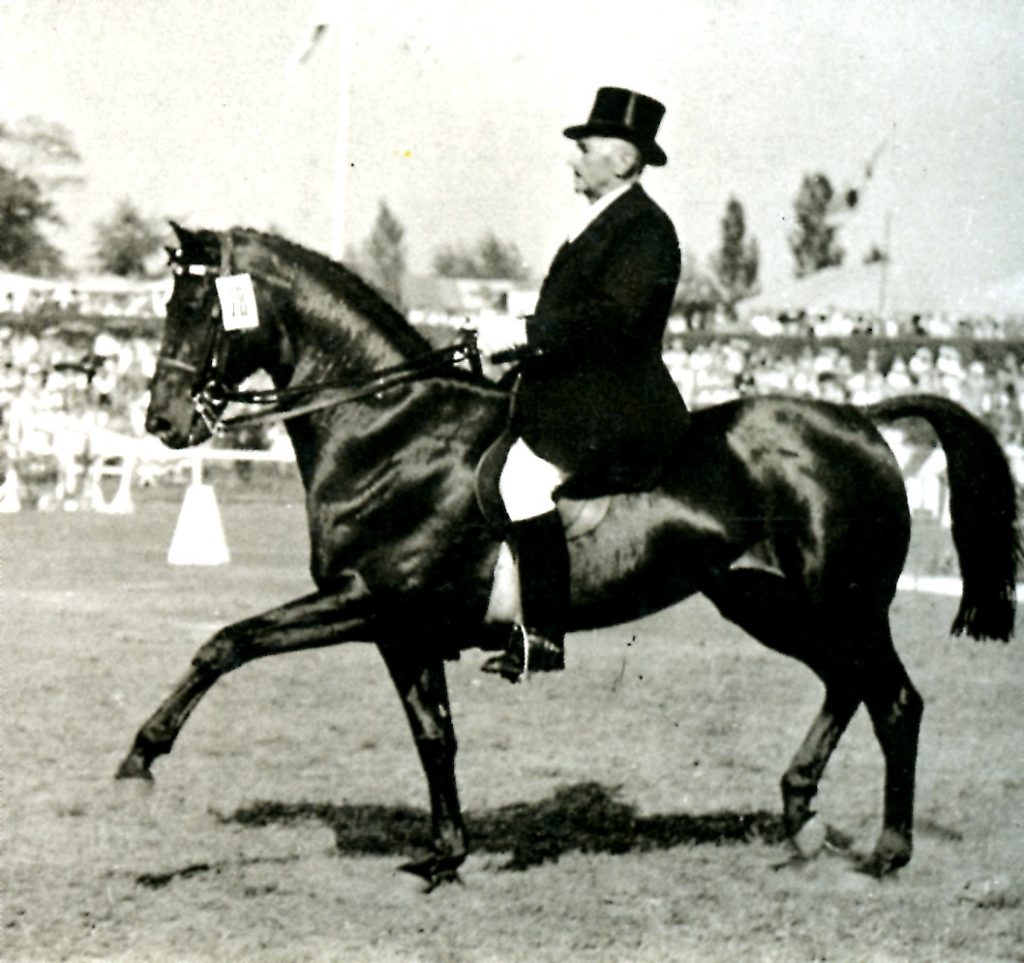
Otto Lorke and the beginning of the ‘modern’ style of dressage
By the time of Steinbrecht, dressage is moving away from the fixed outline of the Renaissance horse – even in 1909, this photo of Otto Lörke looks much more ‘modern’ – Lörke played a crucial role in shaping dressage in the twentieth century through the network of his pupils and pupils’ pupils.
I guess it is because it took so long for a translation of Gymnasium of the Horse to appear in English, that Steinbrecht is largely unquoted in English language equestrian discourse, a pity since his words make far greater sense than some who are more regularly cited.
Consider Steinbrecht again: “Correct dressage training is, therefore, a natural gymnastic exercise for the horse, which hardens its strength and supples its limbs. Such exercise causes the strong parts of its body to work harder in favour of the weaker ones. The latter are strengthened by gradual exercise, and hidden forces, held back because of the horse’s natural tendency towards laziness, are thus awakened. The end result is complete harmony in cooperation of the individual limbs with these forces, enabling the horse to continuously and effortlessly perform, with only the slightest aids from the rider, such regular and beautiful movements as it would demonstrate on its own only fleetingly in moments of excitement.”
Steinbrecht certainly saw his horsemanship as being natural horsemanship as opposed to the artificiality of the French school of Baucher: “The greatest example of such quackery is Mr Baucher who, with the audacity of his claims and the enormity of his promises, has brought the entire equestrian world into uproar and confusion. His method consists in gradually and cunningly robbing the horse of its natural power, which Mr Baucher considers to be the enemy, and to thus make it subservient. He renders his horses so wilted and limp by unnatural bending and twisting in place and so thoroughly robs their natural forward action, that the poor creatures lose all support and are no longer good for any practical purpose.”
I really don’t think we should spend time on Baucher, he is perhaps only known today by those who are wont to chant leg with no hand, hand with no leg at every opportunity, in truth this bit of dogma only appears in the fourteenth volume of his extensive writings, and then only when he was trying to get the contract to train the French army and needed a slogan that was simple enough for the average soldier to grasp and apply.
While we are here we might dispose of another dressage myth, the one that says the dressage movements were trained for use in battle. Pause for a moment. At the world’s greatest demonstration of dressage, Aachen CHIO, there are attendants at the top and bottom of every staircase to prevent spectators moving on the stairs and distracting the horse one hundred metres away in the ring. What chance do you think in the heat of battle of lining up an opposing soldier and making a capriole to eliminate him? It really doesn’t bear thinking about. But don’t you feel better knowing something as beautiful as dressage was not invented for something as ugly as war.
Steinbrecht stressed the NATURAL basis of his principles, the principles that became the modern training scale:
“If I have pointed out in these general comments the difficulties involved in the natural training of the riding horse on a scientific basis, this was not done to frighten amateurs away from the more serious studies of the art, but rather to motivate them for such studies. With a correct view of the principles of this art, it is quite possible to find a way to the desired goal by independent endeavours. Our generation is neither lacking chivalrous spirit nor in talent, nor in the means to return this beautiful art to its highest flourish…”
“The first prerequisite for reawakening a general interest in the art of riding and a contribution in this respect is the main reason for writing this book is to ban from the art everything that is stiff, forced, and pedantic and to overcome the prejudices that a man on a horse must carry himself in strange posture, and that the dressage horse has to walk around as if screwed into an instrument of torture. Instead, the equestrian art is for both the type of natural gymnastic exercise with which it is possible to attain and demonstrate the highest development of physical strength and skill.”
This passage would seem to me to encapsulate what is important about Steinbrecht, the connection between the horse’s natural physical and mental properties and the methods and aims of dressage training – only hinted at in previous texts – now made explicit. This does not mean that Steinbrecht, any more than any of the previous writers/ horsemen, has ‘the last word’ on the subject, since obviously, as Steinbrecht himself stressed, changes in the breeding and the conformation of the horses will produce further changes and refinements.
Principle three: The horse’s body will tell you what he is ready to do. The rider should adapt a natural relaxed position in the saddle. Dressage should look natural not forced.
Ride your horse forward and make him straight!
Really I think we have been travelling through the centuries in the direction of what I think should be the guiding light of dressage training, the German Training scale, a set of principles that combined the best of the teachings of the past with an awareness of the capacity of the horse, though there were to be significant changes in the type and athleticism of the modern horse which change the emphasis of some elements of the scale.
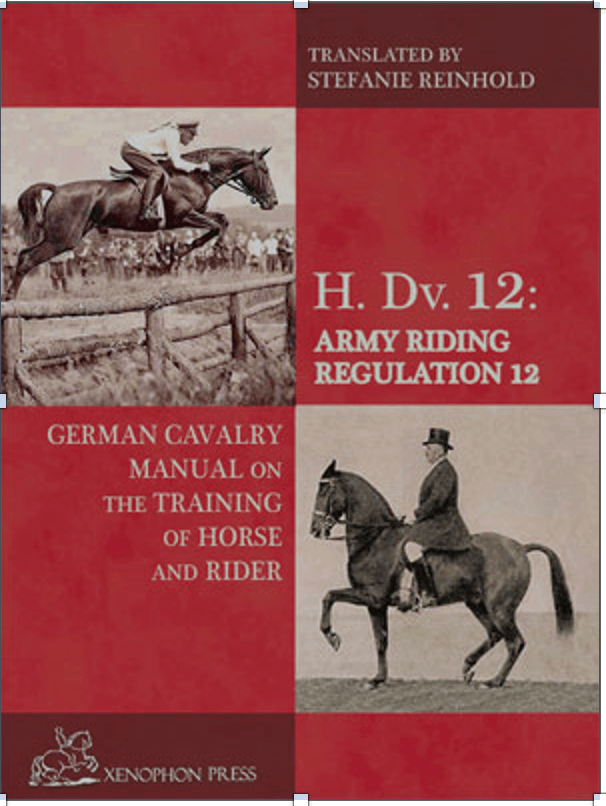
In Germany the first attempt to codify something like the ‘classical principles’ occurred in 1912 in a Cavalry Manual, this was later expanded in 1937. I am extremely grateful to my friend Kerstin Niemann who translated this important document for me.
Here we find the development of the concept of ‘throughness’ – of a contact that is elastic and in a state of changing equilibrium, rather than the Baroque concept where the rein is looped and the horse behind the bit:
From the Cavalry Manual:
As the straightness improves, the throughness of the horse will improve as well. The pushing capacity of the hindquarters can now go its way through the horse up to the mouth and cause the horse to give to the pressure of the bit, bend the neck and chew on the bit.
This is the natural way the horse achieves the correct ‘going through the poll’. It would not be correct to achieve this going through the poll by brutally pulling the neck and head of the horse. Instead it must be the result of the hind legs pushing towards the quiet still hand. This is the only way to fix the neck to the wither. And only if the neck is fixed to the wither it is possible to link forehand and hindquarters.

The principles in action – Willi Schultheis and the Thoroughbred, Chronist
While training a horse, it should never be the way that only separated parts of the horse are worked on, but always the whole horse.Difficulties and disobediences are always connected, and will show in either stiffness of the neck, the back or the hindquarters. The rider should always solve those problems with the horse in motion. The rider can gain a false impression that the horse is giving while it is standing still – whereas this wouldn’t happen when the rider lets the horse stride forward energetically.

Bubi Gunther and Mazepa. Born in 1921, Bubi and his wife, Maria, were enormously successful in the 60s. In 1963, Bubi became the German male dressage champion in Berlin, while an hour later, Maria won the women’s title. He was the official trainer of the German dressage team up to his death in 1974.
And later in the document, we find:
Shape / frame for dressage
The best shape of neck and head is the shape that forms when the neck heightens freely out of the wither, and the upper line of the neck builds towards the poll in a soft bend, of which highest point is the poll itself. The head should be held on a straight line from forehead to nose. Such a frame/shape is the right one to allow the rider to best have an effect on the hindquarters. This state of “aufrichtung” (the horse having his poll at its highest point) should only be asked from the horse for short periods of time, and only in halt or in collected gaits. In higher tempo the rider must allow the horse to lengthen the bent neck and to slightly push the nose forward as well.
Kerstin – who is regarded in Germany as THE expert on the training scale, included this comment with her translation:
“As you can see, in this chapter you cannot even find the word ‘training scale’. I therefore had another look through a few of my books and found a few sentences about the development of the training scale. It is found in a new book for professional riders that I worked on with Hannes Müller. This chapter is written by him with a little help from the dressage judge, Angelika Frömming:
I quote:
“The first military riding instruction was published in 1825, but became well-known in the “Heeresdienstvorschrift 1912”. This book was mainly written by the equestrian experts, Redwitz, Lauffer, Felix Bürkner and Hans von Heydebreck. Their ideas based on the knowledge of the earlier authorities, Ayrer, Seeger and, mostly, Gustav Steinbrecht, who wrote a timeless classic book with his “Gymnasium of the Horse” which was re-written by Hans von Heydebreck in 1935/36. The first issue was published after the death of Steinbrecht by a pupil of his in 1886. His name was Paul Plinzner. In this first edition were a few sentences and thoughts which had to be corrected.
The essence of these earlier writings was then published in 1954 in the first issue of the “guidelines for riding and driving”. In this publication the scale of training still did not have its name, the most remarkable thing was the listing of:
- phase of the horse getting used to everything.
- phase of development of pushing capacity.
- phase of development of carrying capacity.
“The scale of training was first published in the 1980’s. To the above mentioned phases were added rhythm and Losgelassenheit, and these two points were separated in the early 90’s. The listing of these elements shows that classical does not mean old, and shows the developed, harmonious system. It is known like this all over the world and even the rules of the FEI are based on these ideas.”
I started this story inspired by Robert Dover and now return to him, or more precisely to his mentor, Bengt Ljunquist.
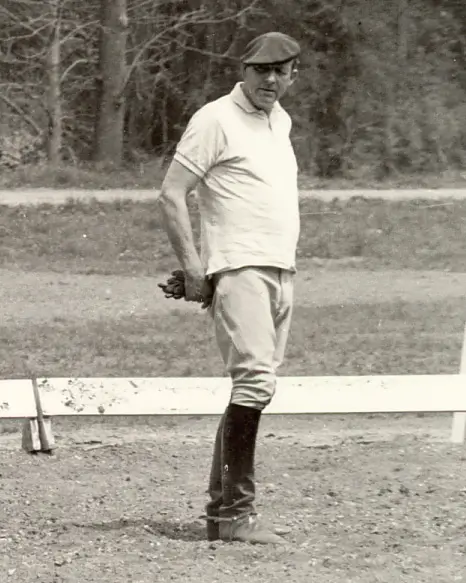
Colonel Bengt Helge Ljungquist (September 20, 1912 – July 15, 1979) a Swedish military cavalry officer, who represented his country at the Olympic Games in both dressage and fencing, and who was a hugely influential figure in the United States as the coach of their dressage team.
By luck I came across a copy of his book Practical Dressage Manual, second hand since,alas, in has long been out of print. It is exactly what it says, a detailed guide to training the horse from the first ride to Grand Prix. In it you will find no flowery turns of phrase, it is a step-by-step manual, and I promise you would be of infinitely more help than any of the works of the old masters.
His strictures on the extended trot rmight help our present day judges: “If the head is too high, the shoulders are locked, the movements of the forelegs too high (flicking of the forelegs), the hind legs drag and the shin bones of the hind legs are not parallel with those of the foreleg.”
He is tough on the riders whose photos he uses, this is of Linda Zang, and earns the comment. “The nose should be positioned slightly more forward and the neck slightly lowered so that the poll remains the highest point.” I hate to think of his reaction to the trot of the current World Champion. Linda, an Olympic judge, retired in 2019, one wonders how she would have scored her own trot today…
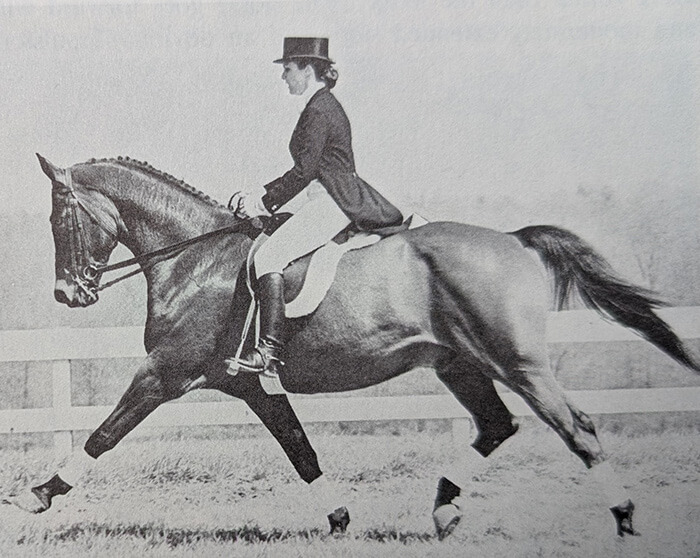
Robert Dover in his reply to the initial question, uses the phrase from the wall of the Swedish Stables where the Colonel rode as a young man, ‘Art ends where violence begins’.
In response to my question, he told me:
He was my mentor from the time I met him when I was fifteen until his death. He created my philosophy of training and teaching and told me before he left for his final time to Sweden that I was responsible to teach what he had taught me because others would forget his words. I have remembered that and teach the Basic Principles of the Art of Dressage as he taught me.”
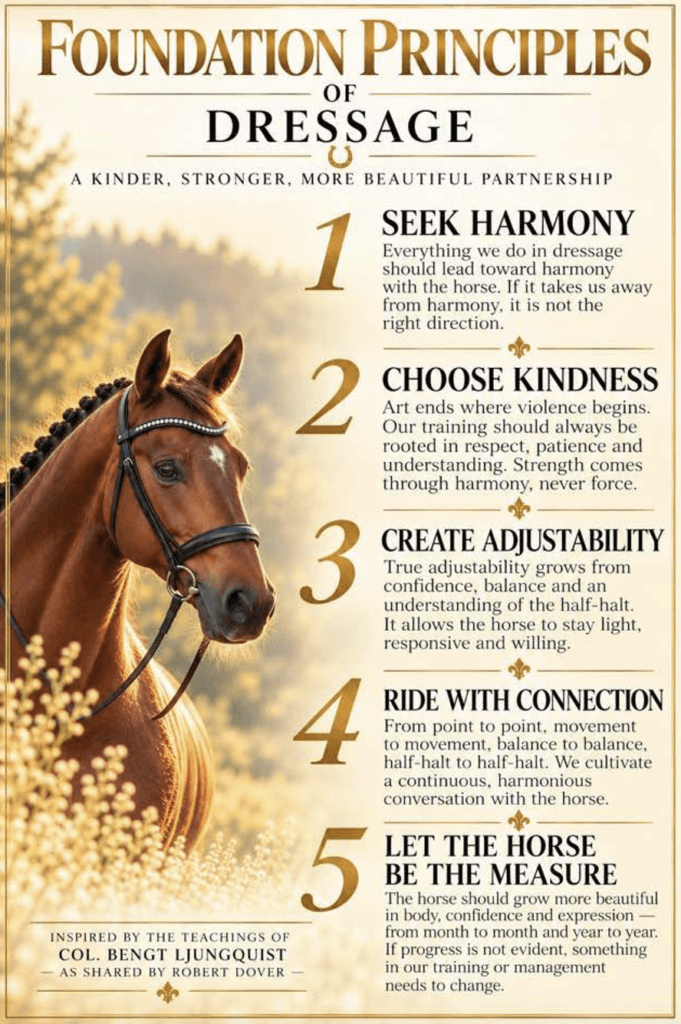
Let’s finish with this beautiful graphic from Tricia Schuh created in response to Robert’s post and find that our guiding light is not some obscure words from the ancient past but today, in the responses of our horses, and the guidance of the real living masters, and look hard, they are there to be found.